CBSE Stream & Career Path Finder
Not sure which path to take in Class 11? Select the area that interests you most to see the corresponding CBSE stream, core subjects, and potential career paths.
Math & Physics
Logic, Equations, Technology
Life Sciences
Health, Nature, Anatomy
Business & Trade
Economics, Money, Management
Society & Arts
History, Law, Psychology
Selected Stream
Core Subjects
Career Opportunities
Quick Summary of the CBSE Framework
- Uniformity: Same curriculum for students across different states in India and abroad.
- NCERT Based: Heavily relies on textbooks developed by the National Council of Educational Research and Training.
- Holistic Approach: Combines academic theory with internal assessments and practicals.
- Competitive Edge: Aligned with major national entrance exams like JEE and NEET.
The Foundation: How the CBSE Curriculum is Built
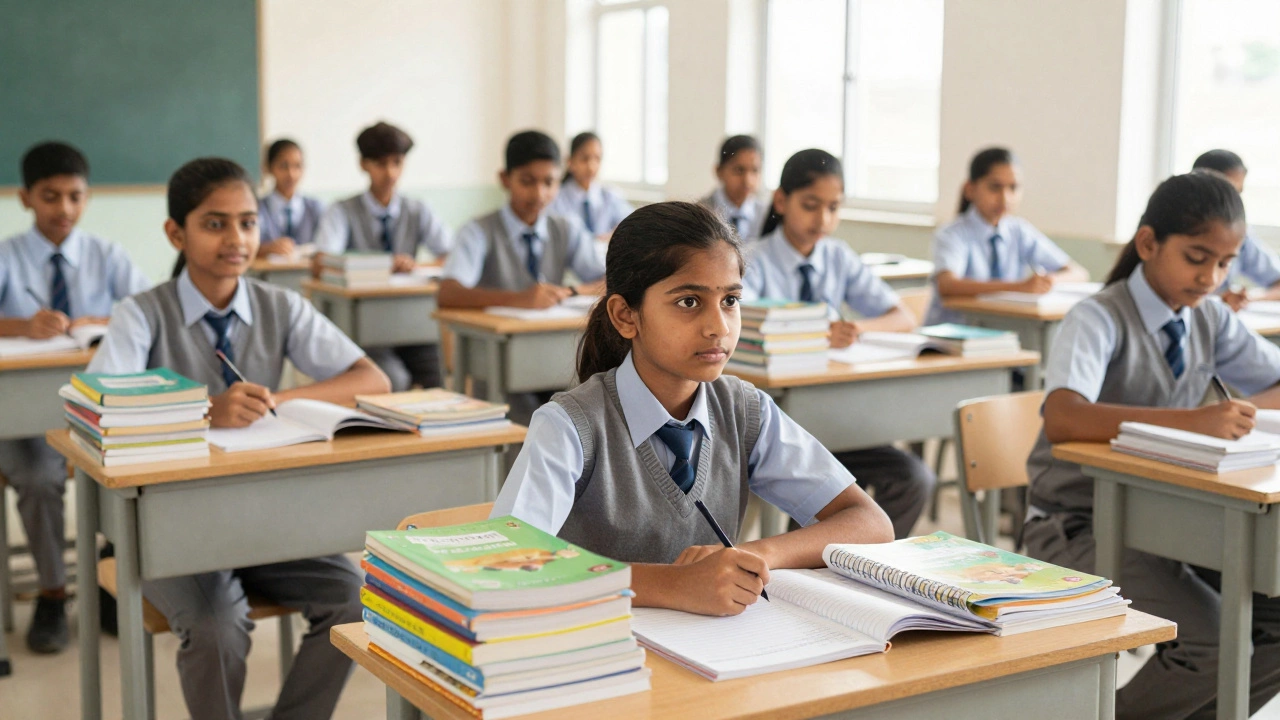
To understand the syllabus, you first need to understand who writes it. The CBSE acts as the administrative body, but the actual content comes from NCERT, which is an autonomous organization that provides high-quality textbooks and pedagogical guidelines for schools. This partnership ensures that a student in Delhi and a student in Chennai are learning the exact same physics laws or historical events.
The syllabus is divided into stages. The preparatory stage (Classes 1-5) focuses on foundational literacy and numeracy. The middle stage (Classes 6-8) introduces more complex concepts in science and social studies. Finally, the secondary stage (Classes 9-12) is where the focus shifts toward specialization and preparation for higher education. This progression is designed to gradually increase the cognitive load on students, moving from simple memorization to critical analysis.
Breaking Down the Core Subjects
The CBSE syllabus isn't a one-size-fits-all block; it's a mix of compulsory and elective subjects. In the early years, everyone studies a broad range of topics. However, as students reach the secondary level, the paths diverge.
In Class 9 and 10, students generally tackle five main subjects: Mathematics, Science (Physics, Chemistry, Biology), Social Science (History, Geography, Political Science, Economics), English, and a second language (often Hindi, Sanskrit, or a regional language). The goal here is to provide a balanced education. For instance, a student might spend their morning solving quadratic equations and their afternoon analyzing the causes of the French Revolution.
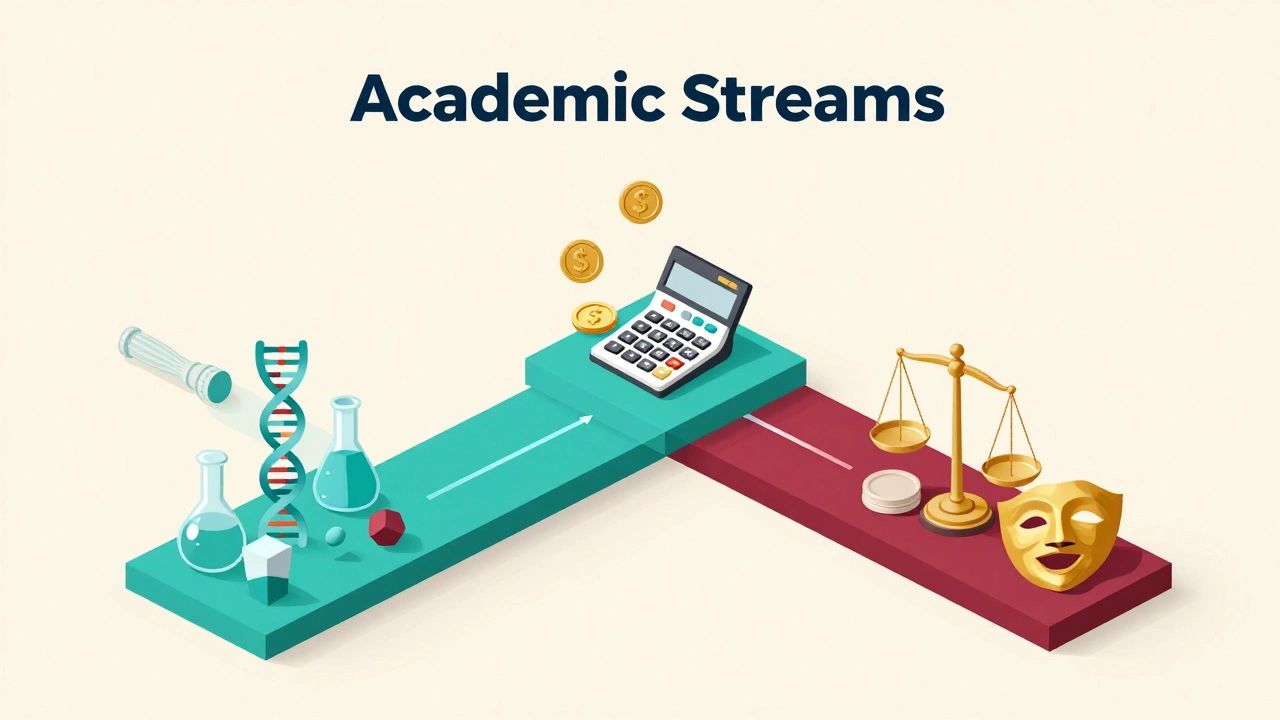
Once students enter Class 11, they choose a "stream." This is a pivotal decision in the Indian education system. The most common streams are:
- Science Stream: Split into Medical (Biology) and Non-Medical (Mathematics). This is the go-to for those aiming for engineering or medicine.
- Commerce Stream: Focuses on Accountancy, Business Studies, and Economics. Ideal for future CAs, entrepreneurs, or finance professionals.
- Humanities/Arts Stream: Covers Psychology, Sociology, Political Science, and History. Perfect for those pursuing law, journalism, or civil services.
| Stream | Core Subjects | Primary Goal | Common Career Paths |
|---|---|---|---|
| Science (Non-Med) | Physics, Chemistry, Math | Technical Mastery | Engineering, Architecture, Data Science |
| Science (Medical) | Physics, Chemistry, Biology | Biological Understanding | Medicine, Pharmacy, Biotechnology |
| Commerce | Accountancy, Economics, Business | Financial Literacy | Chartered Accountancy, MBA, Finance |
| Humanities | History, Pol Science, Sociology | Social & Cultural Analysis | Law, UPSC, Psychology, Design |
Assessment Patterns and the Grading System
One of the most stressful parts of the CBSE experience is the examination. However, the board has shifted away from purely rote learning. The current system uses a combination of Internal Assessment and annual board examinations conducted at the end of the academic year.
Internal assessments usually account for 20% of the total marks. This includes periodic tests, practical lab work, and project assignments. This means a student who struggles with timed exams but excels in hands-on projects still has a path to a good grade. The remaining 80% comes from the final theory paper. These papers are standardized and marked by external examiners to maintain fairness.
The board uses a positional grading system. Instead of just a raw percentage, students receive grades (A1, A2, B1, etc.) based on their performance relative to other students. This reduces the unhealthy competition sparked by a single mark difference between a 94% and a 95%.
The Link Between CBSE and Competitive Exams
Why do so many parents insist on the CBSE board over state boards? The answer lies in the alignment with national-level tests. The JEE (Joint Entrance Examination) for engineering and the NEET (National Eligibility cum Entrance Test) for medical schools are based almost entirely on the NCERT textbooks used in the CBSE syllabus.
If you are studying for these exams, the CBSE syllabus acts as your primary textbook. While coaching centers add "extra" material, the core concepts-the very definitions and formulas-come from the board's curriculum. This synergy makes CBSE a strategic choice for students who plan to pursue professional degrees in India.
Common Pitfalls and How to Avoid Them
Many students make the mistake of treating the syllabus as a checklist. They finish the chapters but don't understand the concepts. In recent years, CBSE has introduced "Competency-Based Questions." These aren't direct questions from the book; they are real-world scenarios that require you to apply what you've learned. For example, instead of asking "What is photosynthesis?", a paper might ask how a plant's growth changes if you change the light color in a room.
Another trap is ignoring the Deleted Syllabus. Every year, the board removes certain topics to reduce the burden on students. Studying these omitted sections is a waste of precious time. Always check the official CBSE website for the latest "Rationalized Syllabus" before starting your revision.
Strategic Study Tips for CBSE Students
To master this syllabus, you need a mix of discipline and smarts. First, prioritize NCERT. Many students buy expensive reference books and ignore the official textbook, but the board exams are designed around the NCERT language. If the textbook says a certain process happens in "three steps," the examiner is looking for those exact three steps.
Second, use previous year question papers (PYQs). Patterns emerge over time. Certain chapters in Chemistry or History are "favorites" of the board and appear almost every year. Identifying these high-yield topics allows you to allocate your study time more effectively.
Finally, focus on the presentation of your answers. In the CBSE world, how you write is almost as important as what you write. Using bullet points, drawing neat diagrams with pencils, and underlining key terms can bump your score from a B2 to an A1 even if the core answer is the same.
Is the CBSE syllabus harder than state boards?
Not necessarily "harder," but it is more standardized. State boards often focus on regional context and may have different difficulty levels. CBSE is designed to be consistent across the country and is specifically aligned with national competitive exams, which can make the workload feel more intense for those aiming for top universities.
Can a student change their stream after Class 11?
Yes, but it is difficult and depends on the school's policy. Usually, students can request a stream change within the first few months of Class 11. Once the academic year is well underway, it becomes nearly impossible because they would have missed too many core concepts in the new stream.
What are the "Rationalized Syllabus" updates?
The board periodically removes outdated or repetitive topics from the NCERT books to make the curriculum more manageable. This is called rationalization. It is crucial to download the latest PDF from the official CBSE website to see which chapters have been deleted for the current academic year.
How do the internal assessments work?
Internal assessments are handled by the school. They include unit tests, notebooks, subject enrichment activities (like projects or debates), and practical exams in labs. These marks are uploaded by the school to the CBSE portal and contribute to the final aggregate score.
Do I need extra books besides NCERT?
For board exams, NCERT is enough. However, for competitive exams like JEE or NEET, you will need advanced reference books to cover the depth and complexity required for those tests. For most students, a good question bank for practice is more helpful than another theory textbook.
Next Steps for Students and Parents
If you are just starting your journey with CBSE, your first move should be to secure the latest NCERT editions. Don't rely on old second-hand books, as the rationalized syllabus might have removed significant portions of the text.
For students in Class 9 or 11, start focusing on "understanding" rather than "memorizing." The board is moving toward a model where you are tested on your ability to apply knowledge. Try explaining a concept to a friend or a sibling; if you can't explain it simply, you haven't mastered the syllabus yet.
Parents should avoid putting too much pressure on the final board exam marks. While they are important, the internal assessments and the shift toward skill-based learning mean that a student's potential is no longer captured by a single three-hour test. Encourage your child to explore the electives they are actually passionate about, rather than just following the trend of the "Science stream."