
Career Path ROI & Timeline Calculator
Time to First Paycheck
You will start working at age 21 vs 22.
Financial Snapshot (First 5 Years of Work)
| Metric | Academic | Vocational |
|---|---|---|
| Net Start-up Cost | -$50,000 | -$10,000 |
| Year 1 Earnings | $65,000 | $55,000 |
| Break-even Point | -- | -- |
Recommendation
Enter your details and click calculate to see our analysis based on current economic trends.
You’re standing at a crossroads. On one path lies the traditional university route-four years of lectures, essays, and theory. On the other is vocational training-hands-on workshops, apprenticeships, and direct entry into a trade. Both lead to jobs, but they get you there in completely different ways. The confusion isn’t just about what you’ll study; it’s about how you’ll learn and where you’ll end up.
The core difference between vocational and general educational pathways comes down to purpose. Academic education focuses on broad knowledge, critical thinking, and theoretical understanding. Vocational training focuses on specific skills, practical application, and immediate job readiness. One prepares you for a wide range of future possibilities; the other prepares you for a specific role right now.
Quick Summary / Key Takeaways
- Vocational training is skill-specific, shorter in duration, and leads directly to employment in trades or technical roles.
- Academic education is broader, longer (often 4+ years), and focuses on theory, research, and professional degrees like law or medicine.
- Vocational graduates often earn money sooner and have lower debt, while academic graduates may have higher long-term earning ceilings in certain fields.
- The "skills gap" means employers are increasingly valuing vocational credentials over generic degrees for many mid-level roles.
- You can combine both: start with vocational skills for quick entry, then add academic qualifications later for advancement.
Defining the Two Paths: Theory vs. Practice
Let’s clear up the terminology first. When people say "educational," they usually mean formal academic schooling-high school leading to university. This path is rooted in the liberal arts tradition. It asks questions like "Why does this happen?" and "What are the historical contexts?" You might spend a semester studying the physics of electricity without ever touching a wire.
Vocational Education and Training (VET), on the other hand, is rooted in the craft tradition. It asks, "How do I fix this?" and "What tool do I use?" If you’re studying electrical work, you’re wiring a circuit board in week two. The goal isn’t just to understand electricity; it’s to pass a licensing exam and get hired by a contractor.
This distinction matters because your brain works differently in each environment. Academic learning relies heavily on abstract reasoning and delayed gratification. You study calculus now because it might help you in engineering five years from now. Vocational learning relies on muscle memory, pattern recognition, and immediate feedback. You weld a joint, inspect it, and if it cracks, you know instantly what went wrong. That instant feedback loop accelerates mastery in practical tasks.
Time, Cost, and the Debt Equation
One of the biggest drivers behind the choice is financial reality. In New Zealand and similar economies, the cost of a bachelor’s degree has risen steadily. A four-year degree can leave a graduate with significant student loans before they’ve even earned their first paycheck. Meanwhile, vocational programs-like those offered through polytechnics or private training establishments-often take 18 months to two years. Some apprenticeships pay you while you learn.
| Feature | Academic Education | Vocational Training |
|---|---|---|
| Duration | 3-6 years (Bachelor’s to PhD) | 6 months - 2 years (Certificates/Diplomas) |
| Focus | Theory, Research, Broad Knowledge | Practical Skills, Job-Specific Tasks |
| Cost | High tuition + living expenses | Lower tuition; often subsidized or paid via apprenticeship |
| Entry Barrier | High (GPA, entrance exams) | Low to Medium (Interest, basic literacy/numeracy) |
| Job Readiness | Delayed (requires internships/co-ops) | Immediate (upon certification/licensing) |
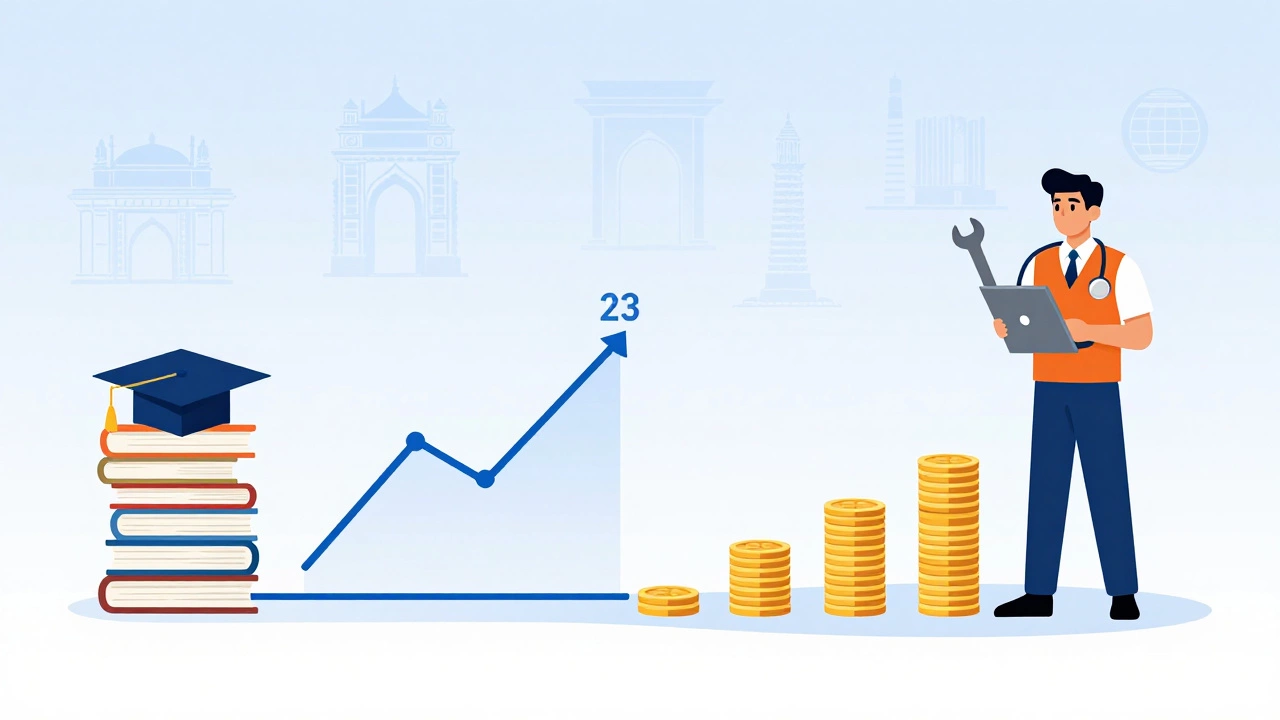
Consider the timeline. A university student might not enter the workforce until age 22 or 23. A vocational student in carpentry or nursing assistance could be earning a full wage by 19. Over a decade, that head start adds up-not just in earnings, but in compound interest if you invest that early income. However, the ceiling matters too. While vocational workers often earn solid middle-class wages immediately, some academic professions (like specialized medicine or corporate law) have much higher long-term potential. But that’s not true for all degrees. Many humanities graduates struggle to find roles that match their salary expectations, leading to underemployment.
Career Outcomes: Stability vs. Flexibility
What kind of jobs are we talking about? Vocational training opens doors to essential services. We need electricians, plumbers, HVAC technicians, dental hygienists, and IT support specialists. These roles are recession-resistant. People always need their homes fixed and their computers working. The unemployment rate for skilled trades is consistently lower than for many general degree holders.
Academic education, particularly in STEM (Science, Technology, Engineering, Math) and business, leads to roles in management, research, software development, and policy. These jobs offer more flexibility in terms of location and remote work options. A software engineer can often work from anywhere, whereas a commercial diver cannot. That flexibility is a huge quality-of-life factor for many young professionals today.
But here’s the catch: automation. Routine cognitive tasks-the kind many entry-level office jobs involve-are increasingly being automated by AI. Meanwhile, manual dexterity and complex problem-solving in unpredictable environments (like fixing a unique plumbing issue in an old house) are very hard to automate. This shift is making vocational skills more valuable than they were twenty years ago. Employers are complaining about a "skills gap"-they have open positions but no candidates with the right hands-on abilities.
The Stigma and the Shift in Perception
For decades, there was a social hierarchy placed on education. University was seen as the "default" success path, while vocational training was viewed as a backup plan for those who couldn’t handle academics. This mindset is crumbling. Why? Because the data doesn’t support it anymore.
In countries like Germany and Switzerland, vocational training is the norm, not the exception. Their youth unemployment rates are among the lowest in the world because students are integrated into the workforce early. In New Zealand, initiatives like the "Earn and Learn" program are pushing apprenticeships to high schoolers, normalizing the idea that you can build wealth and stability through trades.
The stigma persists in some circles, but it’s fading fast. Young people are pragmatic. They see their peers drowning in debt with vague career prospects, while their friends in coding bootcamps or welding programs are buying houses. The cultural narrative is shifting from "Go to college" to "Get a skill."

Hybrid Models: You Don’t Have to Choose Just One
The binary choice between "vocational" and "academic" is outdated. The most resilient careers often blend both. Think of it as stacking credentials.
Imagine starting with a vocational certificate in web design. You get a job quickly, building websites and learning client communication. After three years, you realize you want to move into product management. You go back to finish a bachelor’s degree in business or psychology online, part-time. Now you have the practical experience that pure academics lack, plus the theoretical framework that pure technicians lack. You become indispensable.
This "stacking" approach reduces risk. If the tech industry slows down, your vocational skills keep you employed. If you want to pivot to leadership, your academic degree opens those doors. It’s the best of both worlds, provided you’re willing to commit to lifelong learning.
How to Decide: A Practical Checklist
So, which path is right for you? Ask yourself these questions:
- Do you learn better by doing or by reading? If you get bored sitting in a lecture hall but thrive when you’re building something, lean vocational.
- What is your financial situation? If you need to support yourself or family soon, vocational training offers faster ROI (Return on Investment).
- Is your dream job licensed? Jobs like nursing, accounting, and engineering require specific academic degrees. You can’t apprentice your way into being a surgeon.
- Do you value location independence? If you want to travel or work remotely, digital skills (often taught in hybrid programs) are key. Trades usually require physical presence.
- Are you ready for uncertainty? Academic paths often lead to less defined career trajectories initially. Vocational paths are narrower but clearer.
There is no "better" option, only a "better fit" for your personality, finances, and goals. The worst mistake you can make is choosing a prestigious degree in a field you hate, just to please parents or society. Passion sustains you through the hard parts of any career.
Future-Proofing Your Career
By 2030, the labor market will look drastically different. Artificial intelligence will handle data analysis, basic coding, and content generation. What will remain human-centric? Complex interpersonal care (healthcare, therapy), creative strategy, and skilled manual labor. Both vocational and academic paths need to adapt.
Vocational training is integrating technology. Electricians now use smart grid diagnostics. Chefs use precision fermentation techniques. Academic programs are adding more practical components. Universities are launching micro-credentials and co-op programs to ensure graduates aren’t just theorists.
Your job isn’t to pick a lane and stay there forever. It’s to build a foundation of adaptable skills. Whether that starts with a wrench or a textbook, the key is continuous improvement. The world rewards competence, regardless of where you learned it.
Can I switch from vocational to academic education later?
Yes, absolutely. Many universities accept credits from vocational diplomas or certificates. This is known as credit transfer or prior learning assessment. For example, a diploma in business studies might give you a year’s worth of credit toward a bachelor’s degree. Check with specific institutions about their articulation agreements.
Which path pays more in the long run?
It depends on the field. Generally, professional degrees (medicine, law, specialized engineering) have higher lifetime earnings. However, skilled tradespeople often out-earn many bachelor’s degree holders in the first 10-15 years because they start earning sooner and avoid debt. Top-tier tradespeople can earn six figures, especially if they start their own businesses.
Are vocational jobs less stable?
No, they are often more stable. Essential services like construction, healthcare support, and utilities are rarely outsourced or automated. During economic downturns, people still need repairs and maintenance. Academic roles in industries like marketing or administration can be more volatile during recessions.
What is the "skills gap" mentioned in the article?
The skills gap refers to the mismatch between the skills employers need and the skills job seekers have. Many companies report difficulty finding candidates with practical, hands-on abilities. This makes vocational graduates highly employable, as they possess the exact competencies required for the job from day one.
Do employers prefer degrees over certificates?
It varies by industry. For regulated professions (law, medicine, academia), a degree is mandatory. For tech, trades, and creative fields, portfolios and certifications often matter more. Many tech companies, including major players like Google and IBM, have dropped degree requirements for certain roles, focusing instead on demonstrated skills.