
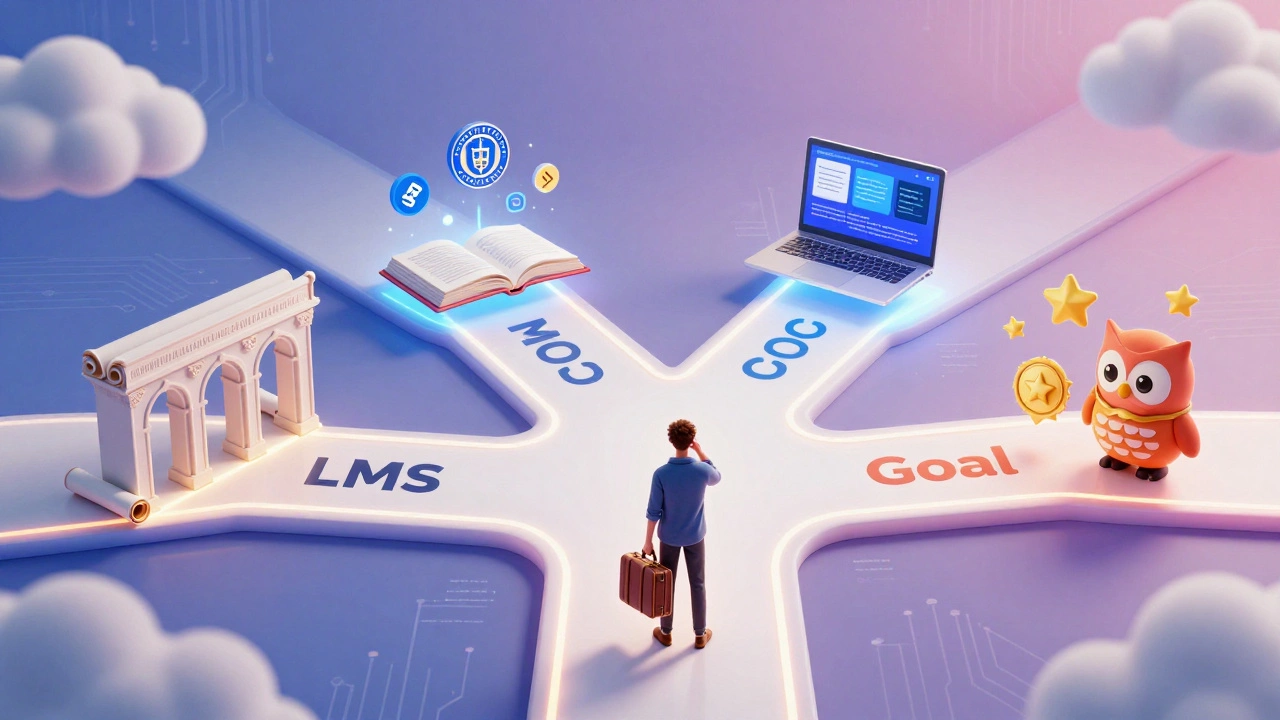
When you think about learning online, you probably picture a website where you watch videos, take quizzes, and maybe chat with a teacher. But not all digital learning platforms are the same. There are four main types that dominate how people learn today - and knowing the difference can save you time, money, and frustration.
Learning Management Systems (LMS)
Think of a Learning Management System as the backbone of online education. These are platforms schools, universities, and companies use to host, track, and deliver courses. They’re not meant for casual learners - they’re built for structure. You’ll find assignments, graded exams, progress reports, and discussion boards all in one place.
Examples include Moodle, Canvas, and Blackboard. These systems are used by over 120 million students worldwide, according to the International Association for Online Learning. If you’re enrolled in an online degree program or corporate training, you’re almost certainly using an LMS. The big advantage? Everything is organized, tracked, and certified. The downside? They’re often clunky, slow, and designed for institutions - not for people who just want to learn something new.
Massive Open Online Course (MOOC) Platforms
MOOCs changed the game in 2012 when platforms like Coursera and edX started offering free university-level courses to anyone with an internet connection. These platforms partner with top universities - Stanford, MIT, Harvard - to bring lectures, readings, and peer-reviewed assignments to the public.
Unlike LMS platforms, MOOCs are designed for self-paced, independent learners. You can take a course on machine learning from MIT without enrolling as a student. Most courses are free to audit, though you pay if you want a certificate. Over 200 million people have signed up for MOOCs since 2012. The real power? You’re not locked into a schedule. You can pause, rewind, and restart whenever you need to.
But there’s a catch: completion rates are low. Studies show fewer than 10% of people who start a MOOC finish it. Without structure or accountability, it’s easy to lose momentum.
Specialized Skill Platforms
These are the platforms built for people who want to learn practical, job-ready skills fast. Think of them as bootcamps in digital form. Instead of theory-heavy lectures, you get hands-on projects, real-world case studies, and feedback from industry professionals.
Platforms like Udemy, Skillshare, and Pluralsight fall into this category. Udemy alone has over 210,000 courses on everything from Excel to Python to digital marketing. The pricing is simple: pay once, own the course forever. No subscriptions, no trials. You can buy a $12 course on Shopify store setup and finish it in two weekends.
These platforms thrive because they’re built for outcomes. Want to learn how to edit videos? There’s a course for that. Want to build a website in WordPress? Done. The downside? Quality varies wildly. There’s no accreditation. No university stamp. You’re trusting the instructor - not an institution. That’s why reading reviews and checking instructor credentials is critical.
Interactive Learning Apps
This is where learning feels like a game. Apps like Duolingo, Khan Academy Kids, and Brilliant use gamification - points, streaks, levels, rewards - to keep you coming back every day. They’re designed for short bursts of learning: 5 to 15 minutes a day, while waiting for coffee or on the bus.
Duolingo, for example, has over 500 million users who’ve learned languages using this model. It works because it’s addictive. You don’t feel like you’re studying. You feel like you’re playing a puzzle game. The same goes for Brilliant, which teaches math and logic through interactive problem-solving.
These apps are perfect for building habits. If you want to learn Spanish or improve your mental math, they’re unbeatable. But they’re not meant for deep learning. You won’t write a thesis on calculus using Brilliant. You won’t become fluent in Japanese using only Duolingo. They’re starters - not finishers.
Which Platform Should You Use?
It depends on what you’re trying to achieve.
- If you’re pursuing a formal credential - a degree, certification, or corporate training - go with an LMS.
- If you want to learn from top universities without enrolling, try a MOOC.
- If you need job-ready skills fast, pick a specialized skill platform.
- If you want to build a daily habit - like learning vocabulary or practicing math - use an interactive app.
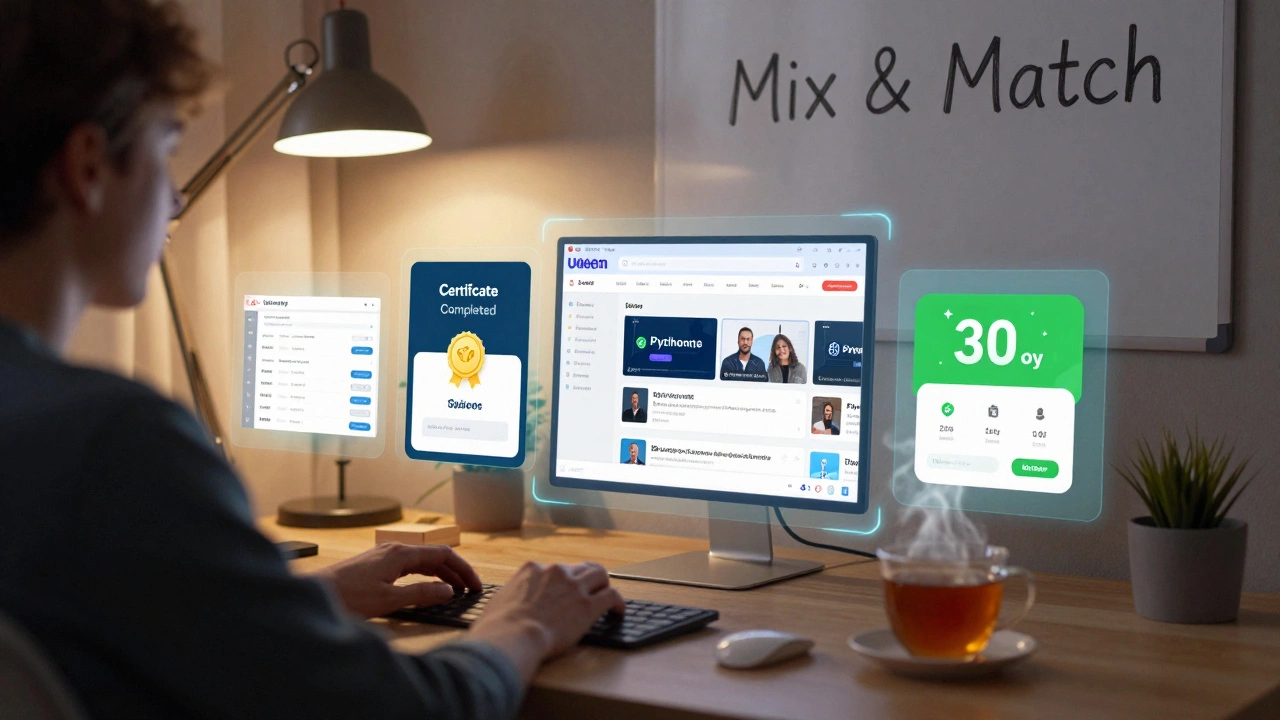
Most successful learners use a mix. Maybe you start with Duolingo to build daily Spanish habits, then take a Coursera course on business communication, and finish with a Udemy course on resume writing. Each platform plays a different role.
The mistake most people make? They pick one and stick with it. That’s like trying to build a house using only a hammer. You need the right tool for the job.
What’s Missing?
There’s a fifth type that’s growing fast: AI-powered tutors. Platforms like Khanmigo and ChatGPT for Education are starting to offer personalized feedback, real-time explanations, and adaptive learning paths. They’re not yet mainstream, but they’re changing how we think about digital learning.
Right now, though, the four platforms above cover 95% of what people use. Whether you’re a student, a professional, or someone just curious, one of these four will fit your needs.
Are all e-learning platforms the same?
No. They serve different purposes. Learning Management Systems are for structured, institutional learning. MOOCs offer university-level content to the public. Skill platforms focus on job-ready training. Interactive apps build daily habits. Choosing the right one depends on your goal.
Can I get a degree from MOOC platforms like Coursera?
Yes - but not directly. Coursera and edX partner with universities to offer accredited online degrees and professional certificates. These are real degrees, recognized by employers, but you enroll through the university, not the platform. The platform just hosts the content.
Is Udemy better than Coursera?
It depends. Udemy has more courses, lower prices, and lifetime access. Coursera has higher-quality, university-backed content and official certificates. If you want a credential for your resume, Coursera is stronger. If you just want to learn web design, Udemy’s cheaper and more practical.
Do interactive learning apps like Duolingo really work?
They work for building habits and basic skills - not fluency. Studies show Duolingo users who practice daily for 34 days learn the equivalent of a university semester of language. But to reach advanced levels, you need conversation practice, grammar study, and immersion - which apps alone can’t provide.
Which platform is best for career switching?
Specialized skill platforms like Udemy, Pluralsight, or LinkedIn Learning are the best. They offer short, focused courses in high-demand fields like data analysis, project management, or UX design. Many include portfolio projects you can show employers - something MOOCs and LMS platforms rarely do.