CBSE Curriculum Fit Finder
Answer these questions to see how well CBSE aligns with your specific needs compared to other boards like ICSE or State Boards.
Recommendation
Match Score: 0%You are standing at a crossroads. Your child is moving to middle school, or perhaps you are an expat parent trying to figure out which curriculum will actually stick when you move from Dubai to London and then back to Mumbai. The acronym CBSE stands for Central Board of Secondary Education, the national-level education board in India that sets standards for secondary and senior secondary schooling appears everywhere. But why does it dominate the conversation? Is it just because it is big, or is there something structurally smarter about how it teaches?
The answer isn't simple preference; it is about alignment. CBSE aligns its curriculum directly with the entrance exams that define careers in India-engineering and medicine. If you want your kid to crack JEE Joint Entrance Examination, the primary gateway for admission to engineering colleges in India or NEET National Eligibility cum Entrance Test, the single entrance exam for undergraduate medical courses in India, the CBSE syllabus is basically the blueprint. Other boards teach subjects; CBSE teaches the test. That’s a massive difference if your end goal is a seat in an IIT or AIIMS.
The Direct Link to Competitive Exams
Let’s be real: in India, high school ends not with a graduation party, but with a brutal filtering process. The NCERT National Council of Educational Research and Training, the body responsible for developing the model textbooks used by CBSE schools textbooks aren't just 'recommended reading'; they are the source code for JEE Main The first stage of the Joint Entrance Examination for engineering admissions in India. When a student solves a problem in a CBSE Class 11 Physics textbook, they are solving the exact type of question that will appear on the entrance exam three years later.
Contrast this with some state boards where the syllabus might include local history topics or literature that has zero weightage in national entrance tests. Or consider international curricula like IB, which focus heavily on critical thinking and internal assessments but often require students to self-study specific factual content for Indian entrance exams. With CBSE, the overlap between board exams and entrance prep is nearly 100%. This reduces the cognitive load on students. They don't need to juggle two different worlds of study material. One book, one mindset, one result.
| Feature | CBSE | ICSE | State Boards |
|---|---|---|---|
| Primary Textbook Source | NCERT (Standardized) | Diverse/Private Publishers | State Government Books |
| JEE/NEET Overlap | High (Direct Syllabus Match) | Moderate (Requires Extra Prep) | Variable (Often Mismatched) |
| Question Style | Conceptual & Application-based | Descriptive & Detailed | Rote Learning Heavy |
| Transferability | Nationwide | Limited Outside Metro Cities | Restricted to State |
Standardization and Mobility
If you live in a city where jobs require frequent relocation, consistency matters more than prestige. Imagine moving from Chennai to Delhi in the middle of Grade 9. If your child was in a specific Tamil Nadu state board school, they might face a complete overhaul of their social science syllabus or math sequence. With CBSE, the syllabus is identical whether the school is in Kashmir or Kanyakumari.
This uniformity is backed by the KVS Kendriya Vidyalaya Sangathan, an organization under the Ministry of Education that runs schools for children of central government employees and NVS Navodaya Vidyalaya Samiti, a residential school system for rural talented students in India networks, which have proven that standardized quality can exist across diverse geographies. For parents, this means no gaps in learning. A student studying Photosynthesis in Grade 8 in Bangalore will find the same depth and terminology when they join a CBSE school in Pune next year. It removes the anxiety of "catching up," allowing kids to focus on mastering concepts rather than decoding new textbooks.
Focus on Conceptual Clarity Over Rote Memorization
Critics often claim CBSE encourages rote learning, but that hasn't been true since the major curriculum reforms around 2017-2019. The current framework emphasizes competency-based education. You won't just be asked to define "Newton's Third Law." You'll be given a scenario involving a rocket launch and asked to apply the law to calculate thrust. This shift mirrors global trends seen in IB International Baccalaureate, a foundation of international education developed by the International Baccalaureate Organization programs, but keeps the rigor grounded in traditional STEM strengths.
The assessment pattern has changed too. Case-based questions now make up a significant portion of board exams. These questions present real-world data-like electricity bills or travel itineraries-and ask students to extract mathematical or scientific insights. It forces teachers to move away from "blackboard dictation" toward interactive problem-solving. If your child struggles with abstract theory but excels at practical application, the modern CBSE structure gives them room to shine without being penalized for poor handwriting or memorizing obscure dates.
Cost-Effectiveness and Resource Availability
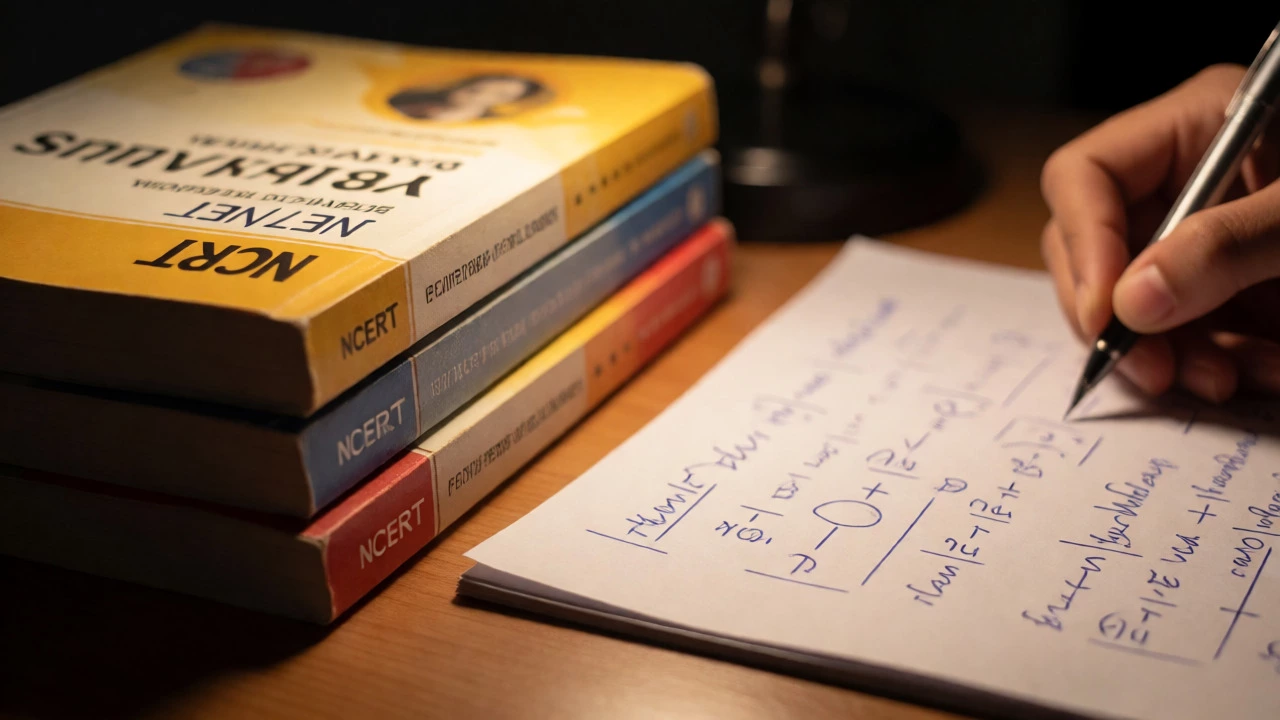
Let’s talk money. Preparing for higher education in India is expensive enough without buying five different sets of reference books. Because CBSE relies on NCERT texts, these books are affordable, widely available, and even free digitally via the official app. In contrast, ICSE schools often recommend multiple private publishers for each subject, driving up costs significantly.
Furthermore, the coaching ecosystem is built entirely around CBSE. Walk into any tuition center in Kota, Hyderabad, or Chandigarh, and you’ll see batches labeled "CBSE + JEE." Teachers have spent decades refining methods specifically for this syllabus. There are millions of solved papers, mock tests, and video lectures tailored to CBSE patterns. Finding resources for a niche state board or a hybrid curriculum requires hunting. For CBSE, the resources come to you. This accessibility levels the playing field for students who cannot afford premium private tutoring.
Global Recognition and Higher Education Pathways
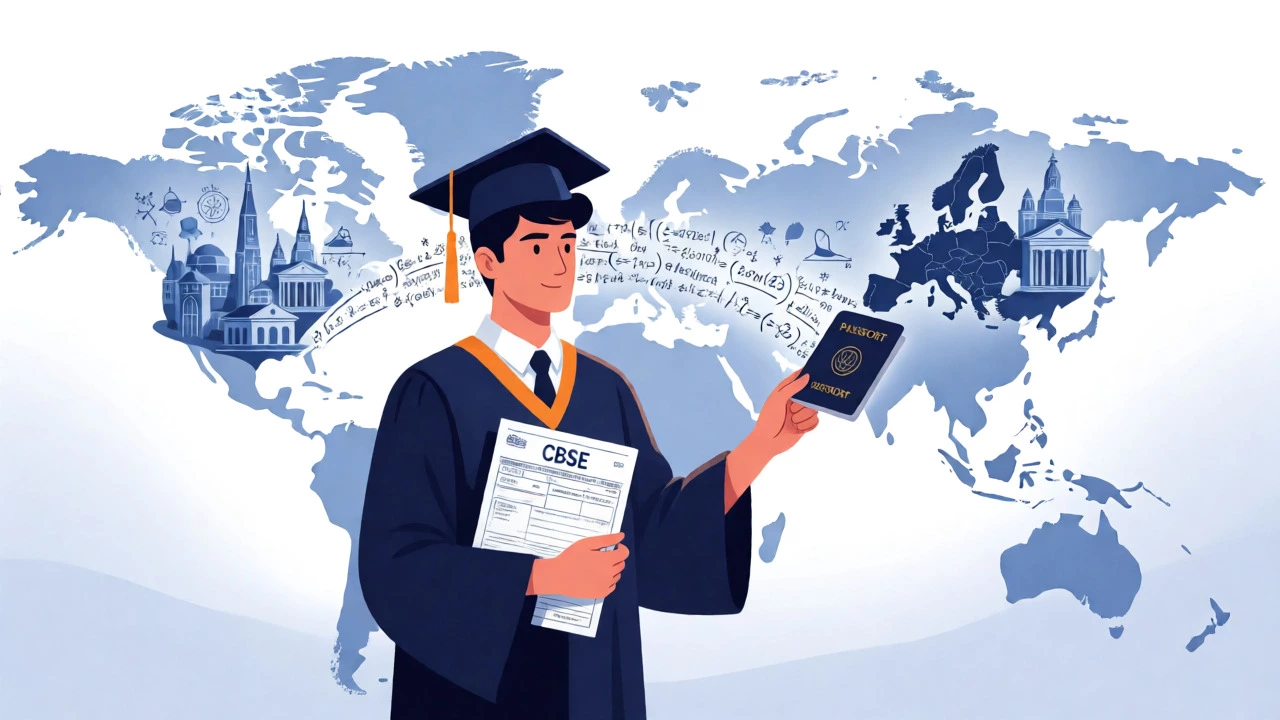
A common misconception is that only international boards prepare students for abroad studies. While Cambridge An examination board based in Cambridge, England, offering qualifications such as IGCSE and A-Levels or IB are popular for direct entry to UK universities, CBSE is increasingly recognized globally, especially in North America and Australia. Universities like those in Canada and many US institutions accept CBSE marks for undergraduate admissions, provided the student demonstrates proficiency through SAT or ACT scores.
Moreover, the strong foundation in Mathematics and Science makes CBSE graduates highly competitive for STEM scholarships abroad. Many top-tier global universities value the rigorous grading standards of CBSE, knowing that a 90% score in CBSE Physics represents a genuine mastery of difficult concepts, unlike grade inflation sometimes seen in other systems. If you plan to send your child abroad after 12th grade, CBSE doesn't close doors; it just requires you to add standard international testing (SAT/IELTS) to the mix.
Which Students Should Choose CBSE?
Not every child fits every mold. Here is a quick heuristic to decide if CBSE is right for your family:
- The Future Engineer/Doctor: If your child is targeting IITs, NITs, or AIIMS, CBSE is non-negotiable. The syllabus alignment saves hundreds of hours of extra study.
- The Mobile Family: If job transfers are likely within India, CBSE ensures seamless academic continuity.
- The Budget-Conscious Parent: Lower textbook costs and abundant free online resources make it economically viable.
- The Practical Learner: If your child prefers applying logic to real-world scenarios over memorizing literary analysis or historical nuances, the CBSE approach suits them.
Conversely, if your child thrives in creative arts, detailed linguistic analysis, or independent research projects, ICSE Indian Certificate of Secondary Education, administered by the Council for the Indian School Certificate Examinations or IB might offer a more fulfilling educational experience. CBSE prioritizes efficiency and standardization; it is less focused on holistic personality development compared to IB.
Frequently Asked Questions
Is CBSE harder than ICSE?
Generally, ICSE is considered more voluminous and detail-oriented, particularly in English and Social Sciences. CBSE focuses more on core concepts in Science and Math. "Harder" depends on the student's strengths; ICSE demands better writing skills and broader knowledge, while CBSE demands sharper logical reasoning and numerical accuracy.
Can CBSE students apply to foreign universities?
Yes, absolutely. Most universities in the US, Canada, UK, and Australia recognize CBSE Class 12 results. However, students usually need to submit additional standardized test scores (like SAT/ACT for the US or IELTS/TOEFL for language proficiency) alongside their CBSE mark sheets.
Why do so many coaching institutes prefer CBSE?
Because the coaching industry in India is primarily geared towards JEE and NEET. Since the CBSE syllabus matches these entrance exams almost perfectly, coaching centers design their entire curriculum around CBSE standards. Teaching a state board syllabus would require creating custom materials, which is less efficient for large-scale teaching.
Are NCERT books sufficient for CBSE board exams?
For scoring high marks (90+), NCERT books are sufficient for understanding concepts and answering most questions. However, for competitive edge and handling tricky application-based questions, students often supplement with previous years' question papers and selective reference guides. But remember, the core answers must align with NCERT definitions.
Does CBSE promote creativity?
Modern CBSE initiatives, such as the inclusion of art-integrated learning and competency-based assessments, aim to boost creativity. However, it is still more structured than progressive curricula like Montessori or IB. Creativity is encouraged within the boundaries of syllabus requirements, focusing on problem-solving innovation rather than open-ended artistic expression.