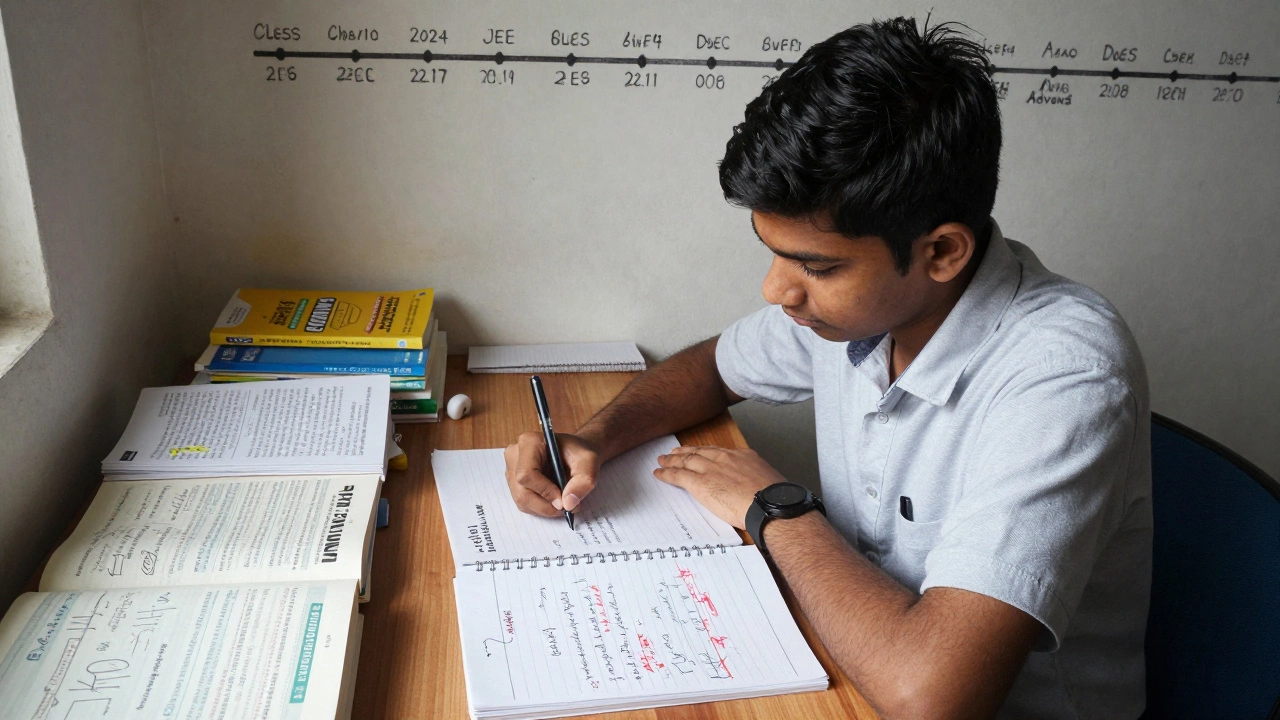
Starting IIT JEE preparation feels overwhelming. You’re not alone. Every year, over 1.5 million students in India take the JEE Main, and only about 25,000 make it to JEE Advanced. And of those, fewer than 10,000 get into an IIT. The competition is fierce, but it’s not impossible. What separates the successful students isn’t genius - it’s strategy, consistency, and starting smart.
Understand the Exam Structure First
The IIT JEE has two stages: JEE Main and JEE Advanced. JEE Main is the qualifying test. If you score above the cutoff, you move to JEE Advanced, which determines your rank and IIT admission. Both exams test Physics, Chemistry, and Mathematics - but the depth and difficulty jump significantly between them.
JEE Main has 90 questions (30 per subject), lasts 3 hours, and is mostly multiple-choice. JEE Advanced has a mix of MCQs, numerical answer type, and matching questions. It’s designed to test deep conceptual clarity, not just memorization. If you don’t understand why a formula works, you’ll struggle in JEE Advanced.
Start by downloading the official syllabus from the NTA website. Don’t rely on coaching institute handouts alone. The syllabus is your roadmap. Mark the topics that appear in both JEE Main and Advanced - these are your priority zones.
Build a Realistic Study Schedule
Most students fail because they treat preparation like a sprint. It’s a marathon. If you’re in Class 11, you have about 18-20 months. That’s enough time - if you use it wisely.
Here’s how to structure your week:
- Monday to Saturday: 6-7 hours of focused study daily
- Sunday: 3-4 hours for revision and a full-length mock test
- Break your day into 90-minute blocks with 15-minute breaks
- Alternate subjects - don’t study Physics for 4 hours straight
For example: Monday morning - Physics (Newton’s Laws), afternoon - Chemistry (Atomic Structure), evening - Math (Quadratic Equations). Rotate weekly so no subject gets neglected.
Track your progress in a simple notebook. Write down what you studied each day. At the end of the week, ask: Did I cover all planned topics? Did I understand them? If not, why?
Choose the Right Study Materials
You don’t need 10 books per subject. Pick one strong resource per subject and master it.
Physics: Start with Concepts of Physics by H.C. Verma. It explains theory clearly and has problems that build from basic to advanced. Once you’re comfortable, move to I.E. Irodov for tougher problems - but only after you’ve nailed the fundamentals.
Chemistry: For Physical Chemistry, use Physical Chemistry by O.P. Tandon. For Organic, Morrison & Boyd is the gold standard. For Inorganic, NCERT is enough - yes, NCERT. Over 60% of JEE Advanced Inorganic questions come directly from NCERT text or examples.
Mathematics: Objective Mathematics by R.D. Sharma is perfect for building speed and accuracy. For advanced problem-solving, use Problems in Mathematics by V. Govorov. Don’t skip coordinate geometry and calculus - they make up nearly 40% of the math paper.
And always, always go back to NCERT. Not just for Chemistry. For Physics and Math too. The board exams and JEE Main share a lot of overlap. Mastering NCERT gives you a solid base and saves you time later.
Practice Daily - But Not Mindlessly
Solving problems is not the same as practicing effectively. Many students solve 50 problems a day and still don’t improve. Why? They don’t analyze mistakes.
Here’s how to practice right:
- Set a timer. Give yourself 45 minutes for 15 questions.
- Solve without looking at solutions.
- After timing, check answers. Mark every wrong one.
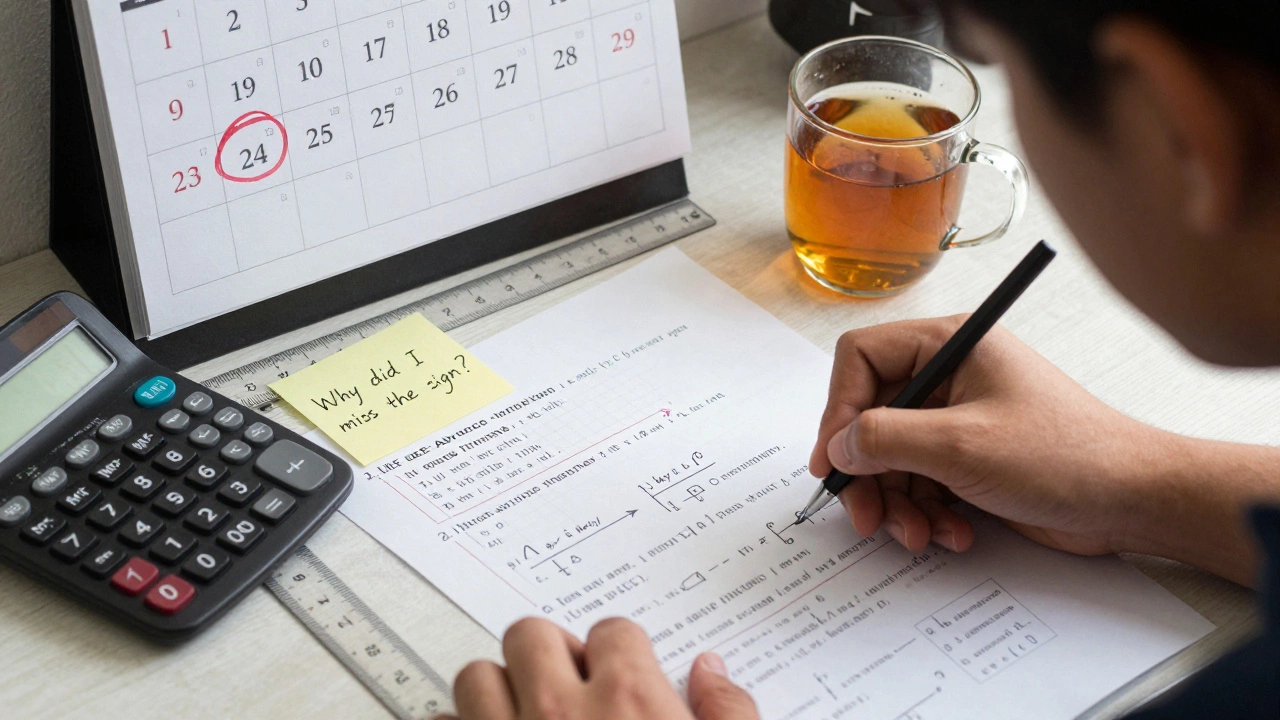
- For each mistake, write down: Why did I get it wrong? Was it a calculation error? Misconception? Forgot a formula?
- Re-solve the problem after 24 hours. If you still get it wrong, flag it for weekly review.
Keep a mistake journal. It’s your most valuable tool. Review it every Sunday. You’ll start seeing patterns - like always messing up sign conventions in thermodynamics or forgetting the chain rule in integration. Fix those, and your score will climb.
Take Mock Tests Seriously
Mock tests aren’t practice. They’re diagnostics. Treat every one like the real exam.
Start taking mocks by the end of Class 11. Use past JEE Main papers from the last 5 years. By Class 12, switch to full JEE Advanced papers. Time yourself strictly. No phone. No breaks. No distractions.
After each mock, do a 3-part analysis:
- Accuracy: How many did you get right vs. guessed?
- Time management: Did you spend too long on one section? Did you skip easy questions?
- Concept gaps: Which topics kept appearing in wrong answers?
Don’t just check your score. Check your strategy. If you’re scoring 180/300 in mocks but spending 2.5 hours on Physics, you need to work on speed. If you’re missing 10+ questions in Organic Chemistry, you need to revisit your notes.
Stay Mentally and Physically Strong
Preparation isn’t just about books. Your mind and body are your tools. Sleep 7-8 hours. Eat balanced meals. Move your body - even a 20-minute walk helps clear mental fog.
Stress will come. You’ll have days when you feel like giving up. That’s normal. What matters is what you do after.
When you’re overwhelmed:
- Take a 10-minute break - breathe, stretch, listen to music
- Talk to someone - a teacher, a friend, a sibling
- Remember: one bad day doesn’t ruin your chances
Don’t compare yourself to others. Your journey is yours. Someone else’s 12-hour study day isn’t your benchmark. Focus on your own progress.

What Not to Do
Here are common mistakes that derail JEE aspirants:
- Skipping NCERT for theory - it’s the foundation
- Buying too many books - mastery beats quantity
- Only solving easy problems - you need to challenge yourself
- Ignoring weak topics - they’ll haunt you in mocks
- Studying late into the night - sleep kills retention
- Waiting for "perfect timing" - start today, not next month
There’s no magic trick. No secret coaching center. No shortcut. Just consistent, smart work over time.
Final Tip: Start Now - Not Tomorrow
If you’re reading this and thinking, "I’ll start after my exams," or "I’ll begin in April," you’re already behind. The clock is ticking. Every day you delay, you lose 6-7 hours of potential learning.
Today, open your NCERT Chemistry textbook. Read one chapter. Solve five problems. Write down two things you didn’t understand. That’s it. Just one small step.
Tomorrow, do the same. And the next day. Progress isn’t loud. It’s quiet. It’s in the notes you write, the problems you solve, the mistakes you fix. That’s how you start preparing for IIT JEE - one day, one problem, one step at a time.
Can I prepare for IIT JEE without coaching?
Yes, absolutely. Thousands of students crack IIT JEE every year without coaching. What matters is discipline, access to the right resources (NCERT, H.C. Verma, R.D. Sharma), and a structured study plan. Online platforms like YouTube channels (e.g., Khan Academy, Unacademy Free Lectures) and free test series can replace coaching if used consistently.
How many hours should I study daily for IIT JEE?
Quality matters more than quantity. Aim for 6-7 focused hours daily during Class 11 and 12. That includes self-study, practice, and revision. Studying 10 hours with distractions or low concentration is less effective than 6 hours of deep focus. Break your time into 90-minute blocks with short breaks to maintain mental freshness.
Which subject should I start with in IIT JEE preparation?
Start with the subject you’re most comfortable with - it builds confidence. But don’t neglect the others. Most students find Physics hardest initially because it requires strong math skills and conceptual thinking. Chemistry is often easier to score in early on because it’s more memorization-based. Math requires constant practice. Balance all three from Day 1.
Is Class 11 syllabus more important than Class 12 for JEE?
Yes, Class 11 forms the foundation. Topics like Laws of Motion, Thermodynamics, Chemical Bonding, Trigonometry, and Coordinate Geometry are used heavily in Class 12 topics. If you don’t understand Class 11 concepts well, you’ll struggle with advanced problems in Class 12. Aim to finish the Class 11 syllabus by December of that year so you can focus on revision and advanced practice in Class 12.
When should I start solving previous year papers?
Start with one previous year paper after you’ve covered 60-70% of the Class 11 syllabus - usually around March-April of Class 11. This helps you understand the exam pattern. By Class 12, solve at least one full paper per week. Analyze every mistake. Don’t just solve - review.
Can I crack JEE Advanced with only NCERT books?
NCERT is essential, especially for Chemistry and foundational concepts in Physics and Math. But for JEE Advanced, you need deeper problem-solving practice. NCERT won’t give you the level of difficulty required. Use H.C. Verma for Physics, R.D. Sharma for Math, and advanced problem books like I.E. Irodov or V. Govorov to bridge the gap. NCERT gives you the base; advanced books give you the edge.
Next Steps: Your Action Plan
Here’s what to do in the next 7 days:
- Download the official JEE syllabus from nta.ac.in
- Buy or borrow: NCERT Class 11 Physics, Chemistry, and Math textbooks
- Set up a study timetable - block out 6 hours daily
- Start with Chapter 1 of NCERT Chemistry - read, highlight, solve all in-text examples
- Write down 3 things you found confusing
- Find one free YouTube channel that explains JEE concepts clearly
- Commit to doing this every day - no exceptions
You don’t need to be perfect. You just need to show up. Consistently. Every day. That’s how you start preparing for IIT JEE - and that’s how you win.