
English Fluency Training Planner
Step 1: Select Your Methods
Choose at least one technique to include in your plan.
Shadowing
PronunciationListen and repeat audio simultaneously to build muscle memory.
Self-Narration
VocabularyTalk aloud about your daily activities to connect words to reality.
Record & Review
Grammar/FlowRecord answers to common questions and analyze errors.
Online Groups
InteractionJoin structured communities for real-time conversation practice.
Step 2: Set Commitment
Consistency beats intensity.
Your Personalized Fluency Schedule
Total Time: --| Method | Frequency | Duration | Focus Area |
|---|
You know the grammar rules. You can read a novel without stopping for a dictionary. But when someone asks you a simple question in real life, your mind goes blank. This is the most common frustration for learners who want to speak English fluently. The gap between knowing a language and using it naturally isn't about intelligence; it’s about training your brain to process information in real-time. Most people try to fix this by studying more textbooks, but that rarely works. Instead, you need to shift from passive learning to active output. Here is how you can retrain your brain to speak confidently and clearly.
Why Your Brain Freezes During Conversation
To fix the problem, you first need to understand why it happens. When you speak a second language, your brain has to perform three tasks simultaneously: translate thoughts into words, check grammar rules, and monitor pronunciation. For native speakers, this process is automatic. For learners, it requires conscious effort. This creates a bottleneck called "cognitive overload."
Imagine trying to drive a car while explaining every gear change out loud. You would stall. That is what happens when you overthink your speech. The goal of training yourself is not to learn more vocabulary, but to make these processes automatic. You need to build neural pathways that allow you to access words without translating them from your native language first. This shift from translation to direct association is the foundation of fluency.
The Power of Shadowing Technique
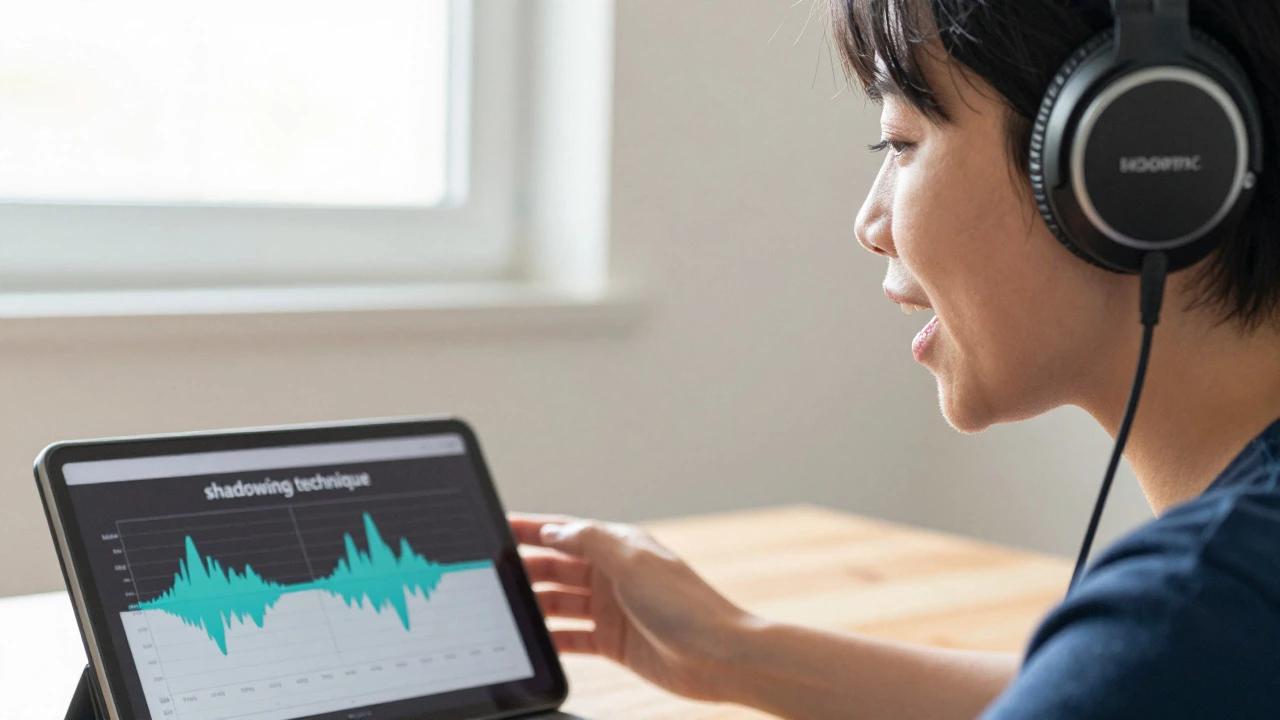
One of the most effective ways to bridge the gap between listening and speaking is a method called shadowing. Developed by linguist Alexander Arguelles, this technique involves listening to native speech and repeating it almost simultaneously, like an echo. It forces your mouth muscles to move in rhythm with the natural flow of the language.
- Find a short audio clip or video with a transcript. Podcasts like "6 Minute English" from BBC or TED Talks are great resources because they use clear, standard English.
- Listen to one sentence. Pause the audio.
- Repeat the sentence aloud, mimicking the speaker's speed, intonation, and emotion exactly.
- Once you get comfortable, try to speak along with the audio without pausing.
This might feel awkward at first. You will stumble over words. That is normal. The physical act of shaping your mouth around English sounds builds muscle memory. Over time, this reduces the mental energy required to pronounce words correctly, freeing up your brain to focus on what you want to say rather than how to say it.
Talk to Yourself: The No-Pressure Practice
Many learners wait until they find a conversation partner to practice speaking. This is a mistake. Waiting creates pressure and anxiety. The best way to start is by talking to yourself. There is no audience, so there is no fear of judgment. You can narrate your daily activities as you do them.
For example, while cooking, say out loud: "I am chopping the onions now. They smell strong. I need to add salt soon." If you forget a word, look it up immediately and use it in the next sentence. This connects new vocabulary directly to your immediate reality. Studies in second language acquisition show that contextualized learning-where words are tied to specific actions or environments-is retained much better than rote memorization of lists.
You can also record yourself answering common questions like "Tell me about your job" or "What did you do last weekend?" Listen to the recording. You will likely notice pauses, filler words (like "um" or "uh"), and grammatical errors. Don’t be hard on yourself. Use this feedback to identify specific areas to improve. Re-record the answer after practicing those weak points. You will hear the improvement quickly.
Create an English-Only Environment
Your brain adapts to its environment. If your phone, TV, and social media are all in your native language, your brain defaults to that mode. To train fluency, you need to increase your exposure to English input. Change your phone’s language settings to English. Follow English-speaking influencers on topics you enjoy, whether that’s gaming, cooking, or finance. Watch movies with English subtitles, not subtitles in your native language.
This immersion doesn't mean you must live in an English-speaking country. It means curating your digital space. When you consume content in English, pay attention to how people connect ideas. Notice phrases like "on the other hand," "as a result," or "by the way." These discourse markers help structure your own speech and make you sound more fluent, even if your grammar isn't perfect.
Join Online Speaking Communities
Eventually, you need to interact with other humans. However, traditional language exchange apps can be intimidating. Many users treat them like dating apps or casual chat rooms, which can distract from learning. Instead, look for structured communities focused on professional development or specific interests.
Platforms like Meetup.com often have local or virtual groups dedicated to English conversation. Alternatively, online forums related to your hobbies (such as Reddit communities for coding, gardening, or travel) provide text-based interaction that can transition into voice chats. The key is to find a context where the focus is on the topic, not just the language. When you care about the subject matter, you care less about making mistakes. This lowers your affective filter-a term coined by linguist Stephen Krashen to describe the emotional barrier that blocks language acquisition when anxiety is high.
| Method | Best For | Time Commitment | Key Benefit |
|---|---|---|---|
| Shadowing | Pronunciation & Intonation | 15-20 mins/day | Builds muscle memory |
| Self-Narration | Vocabulary Recall | Throughout the day | Zero pressure practice |
| Recording & Review | Grammar & Flow | 30 mins/week | Objective feedback |
| Online Groups | Real-time Interaction | 1-2 hours/week | Social confidence |

Focus on Communication, Not Perfection
A major roadblock to fluency is the desire to be perfect. Many learners stay silent because they are afraid of making grammar mistakes. Remember that communication is about transferring meaning, not reciting textbook rules. Native speakers make mistakes too. They use slang, drop words, and speak in fragments. Your goal is to be understood, not to pass a grammar exam.
If you forget a word, describe it. If you don't know the past tense of a verb, use the present tense and add "yesterday." Keep the conversation moving. This strategy, known as circumlocution, is a vital skill for fluency. It keeps your brain engaged in the flow of dialogue rather than getting stuck on a single missing piece of data. Over time, as you hear others correct you gently or model the correct form, your internal grammar engine will update itself naturally.
Consistency Beats Intensity
You don't need to study for five hours once a week. You need to engage with the language for twenty minutes every day. Language learning is like building a muscle. Small, consistent workouts yield better results than occasional marathon sessions. Set a realistic schedule. Maybe it’s ten minutes of shadowing during your morning coffee and fifteen minutes of self-narration while doing dishes. Stick to it for three months. You will see a dramatic difference in your ability to think and speak in English.
How long does it take to become fluent in English?
There is no fixed timeline, as it depends on your starting level and daily practice time. However, with consistent daily practice of 30-60 minutes, most learners notice significant improvements in conversational ability within 3 to 6 months. True fluency, where you can discuss complex topics effortlessly, may take 1 to 2 years of regular engagement.
Is it better to learn with a tutor or alone?
Both approaches have value. Tutors provide personalized feedback and structured lessons, which are excellent for correcting persistent errors. Self-study offers flexibility and allows you to tailor content to your interests. A hybrid approach often works best: use tutors for weekly check-ins and practice independently daily through shadowing and self-talk.
What should I do if I freeze up during a conversation?
Take a deep breath and buy yourself time. Use filler phrases like "Let me think about that" or "That's an interesting question." Then, simplify your response. Don't try to construct a complex sentence. Say what you can in simple terms. Remember, the listener is usually interested in your idea, not your grammar perfection.
Can watching movies really help me speak better?
Yes, but only if you watch actively. Passive viewing helps with listening comprehension, but active shadowing-repeating lines after characters-helps with speaking. Choose shows with everyday dialogue rather than heavy accents or specialized jargon. Sitcoms or slice-of-life dramas are often better for beginners than action movies with fast-paced shouting.
Should I stop using my native language entirely?
You don't need to ban your native language completely, but you should create dedicated English-only zones. For example, keep your bedroom or commute time as English-only spaces. Bilingualism is a strength, not a weakness. Using your native language for rest and relaxation can prevent burnout, allowing you to focus fully on English during practice sessions.