
Quick Wins: The Salary Breakdown
| Metric | Java | Python |
|---|---|---|
| Entry-Level Average | $75k - $95k | $70k - $90k |
| Mid-Senior Level | $120k - $160k | $130k - $180k |
| Primary Industry | Enterprise/Banking | AI/Data Science |
| Learning Curve | Steeper | Gentle |
If you want the short answer, Java generally has a higher floor for beginners because of its dominance in massive corporate systems. However, Python has a higher ceiling for specialists, especially those moving into artificial intelligence. If you're looking for the Java vs Python salary winner, it depends on whether you prefer the stability of a corporate giant or the explosive growth of a tech startup.
The Java Powerhouse: Enterprise and Stability
When we talk about Java is a high-level, class-based, object-oriented programming language designed to have as few implementation dependencies as possible , we're talking about the backbone of the corporate world. Java is the "old reliable" of the tech industry. Because it's built for scale and security, it is the primary choice for the Banking Sector and huge retail operations.
Why does this matter for your paycheck? Large enterprises like JPMorgan Chase or Walmart don't just write code; they maintain massive, complex systems that cannot fail. This creates a huge demand for developers who understand how to manage memory and optimize performance in a strict environment. You'll often find that Java roles are tied to Backend Development, where the focus is on creating robust servers and APIs. Because the learning curve is steeper-you have to deal with verbose syntax and strict typing-the barrier to entry is higher, which keeps the starting salaries competitive.
If you enjoy building things that are meant to last for decades and serve millions of users simultaneously, Java is your best bet. The pay is steady, the benefits are usually corporate-grade, and the job security is among the highest in the industry because migrating a massive Java codebase to another language is an expensive nightmare for companies.
The Python Explosion: AI and Flexibility
On the other side of the ring, we have Python is an interpreted, high-level, general-purpose programming language known for its readability and versatility . If Java is a heavy-duty industrial crane, Python is a Swiss Army knife. It's fast to write, easy to read, and incredibly flexible.
Python's earning potential is currently being driven by the AI gold rush. Because Python is the primary language for Machine Learning and Data Science, the people making the most money aren't just "coders"-they are specialists. A Python developer who knows how to use PyTorch or TensorFlow to build a predictive model for a hedge fund will almost always outearn a generalist Java developer.
However, there's a catch. Because Python is so easy to learn, the market is flooded with beginners. This can actually drive down the salary for "Junior Python Developers" who only know the basics. To hit those high-salary brackets, you can't just know the language; you have to master the libraries. You need to be able to manipulate massive datasets using Pandas or build complex web apps with Django. In Python, the money is in the specialization, not the language itself.
Comparing the Career Paths
To really understand which pays more, you have to look at the "Job-to-be-Done." If your goal is to work for a Fortune 500 company in a structured environment, Java is the path. If your goal is to work in a fast-paced startup or a research lab, Python is the way to go.
Consider these two real-world scenarios:
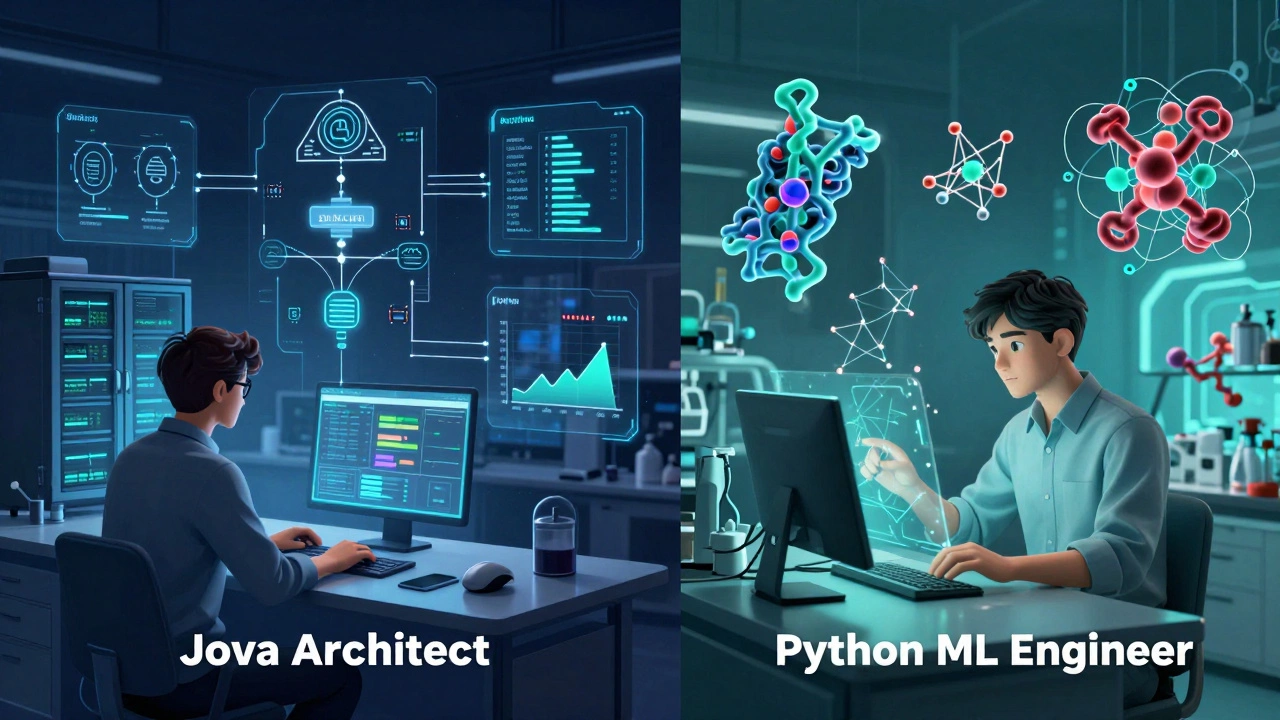
- The Java Architect: Imagine a developer at a global logistics company. They spend their day ensuring that the tracking system for 10,000 trucks doesn't crash during peak season. They are paid for their ability to prevent disaster and maintain stability. Their salary growth is linear and predictable.
- The Python ML Engineer: Imagine a developer at a biotech startup. They are writing scripts to analyze protein folding to find a new drug. They are paid for their ability to find insights in data that no one else can see. Their salary can jump exponentially if their model proves successful.
One thing to keep in mind is the ecosystem. Java developers often move into Cloud Computing roles, specifically working with AWS or Azure, which further boosts their earning potential. Python developers often bridge the gap into Quantitative Analysis in finance, which is one of the highest-paying niches in the world.
The Hybrid Advantage
Here is a secret that most coding classes won't tell you: the highest-paid developers aren't loyal to one language. They are polyglots. In the modern tech stack, it's very common to see a project where Java handles the heavy lifting of the backend infrastructure while Python is used for the data analysis scripts and AI integrations.
If you learn Java first, you'll understand the deep mechanics of how computers manage memory and how object-oriented programming really works. Moving from Java to Python is like moving from a manual transmission car to an automatic; it's a breeze. Going the other way is much harder. Many pros suggest starting with Java to build a strong foundation, then adding Python to unlock the high-paying AI and Data science markets.
By becoming a "T-shaped" developer-deep expertise in one and broad knowledge in the other-you remove the risk of a market dip in one specific language. You become an asset that can solve any problem, regardless of the tool, and that's when you gain the leverage to negotiate the highest salaries.

Common Pitfalls in Choosing Your Path
Don't fall for the trap of chasing the "hottest" language. A few years ago, everyone was rushing into Ruby on Rails; now, while it still pays well, the growth has stalled. Python is currently the "hot" language because of AI, but remember that the demand is for *experts*, not just people who can write a "Hello World" script.
Avoid these common mistakes when deciding:
- Ignoring the Industry: Don't pick Python if you want to work in legacy banking systems; you'll be fighting an uphill battle.
- Underestimating the Effort: Don't pick Java just for the starting salary if you hate strict rules and verbose code. You'll burn out before you hit the senior pay grade.
- Thinking Language = Job: A language is just a tool. A "Python Developer" is actually a Data Scientist, a Web Developer, or an Automation Engineer. The job title dictates the pay more than the language does.
Is Python easier to learn for a complete beginner?
Yes, Python has a much simpler syntax that resembles English more closely than Java does. You don't have to worry about complex boilerplate code just to print a line of text, which makes it less intimidating for people who have never coded before.
Do Java developers have better job security?
Generally, yes. Because Java is so deeply embedded in the infrastructure of banks, insurance companies, and government agencies, these organizations cannot easily switch languages. This creates a permanent demand for Java developers to maintain and upgrade these critical systems.
Which language is better for getting into AI?
Python is the undisputed king of AI and Machine Learning. Almost all the major libraries for AI, such as TensorFlow and PyTorch, are designed to be used with Python, making it the essential choice for anyone pursuing a career in artificial intelligence.
Can I learn both at the same time?
It's not recommended. Learning two languages simultaneously can lead to confusion with syntax and logic. It's better to master one, understand the core concepts of programming (like loops, variables, and functions), and then pick up the second one. It will be much faster the second time around.
Will AI replace both Java and Python developers?
AI is changing how we write code, but it's not replacing the need for engineers. Instead of writing every line of syntax, developers are becoming "architects" who guide the AI to build the right system. The most valuable developers will be those who use AI to work faster, regardless of the language they use.
Next Steps for Your Career
If you're still undecided, look at the job boards in your specific city or the region where you want to work. If you see a sea of "Enterprise Architect" or "Backend Engineer" roles at large firms, lean toward Java. If you see a lot of "Data Analyst," "ML Engineer," or "Growth Hacker" roles at startups, go with Python.
For those who are totally stuck: start with Python for two weeks. If you find it too "loose" and want more structure, switch to Java. If you love the speed and are eager to start building AI tools, stick with Python. The most important thing is to start coding today-the salary follows the skill, not the other way around.