
CBSE Subject Strategy Finder
Which subject is currently your biggest challenge? Select one to see the tailored strategy for your brain type.
Strategy
The Core Challenge:
Challenge description goes here.
Your Action Plan:
Quick Takeaways for Students
- Mathematics: Hardest for those who struggle with abstract logic and application.
- Physics: Toughest due to the blend of complex theory and mathematical derivation.
- Chemistry: The most fragmented, requiring both rote memorization and conceptual understanding.
- Accountancy: High pressure due to the precision required and the volume of numerical data.
- History: Challenging because of the massive syllabus and the need for analytical writing.
The Mathematics Struggle: Logic vs. Fear
For a huge chunk of students, Mathematics is the study of numbers, shapes, and patterns, focusing on algebra, geometry, and calculus in higher grades is the undisputed champion of difficulty. Why? Because it is cumulative. If you missed a concept in Class 8, Class 10 feels like a foreign language. In the CBSE board exams, the shift toward 'competency-based questions' means you can't just memorize a formula and plug in numbers. You have to understand the why behind the step.
Take Calculus in Class 12, for example. Differentiation and Integration aren't just about following rules; they are about visualizing how things change. When students hit a wall here, it's usually because they're trying to memorize the steps of a problem rather than understanding the underlying logic. The secret to beating Math isn't doing more problems-it's doing the right problems. If you can't explain the logic of a theorem to a friend, you haven't mastered it yet.
Physics: Where Concepts Meet Calculation
If Math is about the rules, Physics is the natural science that studies matter, motion, energy, and force is about applying those rules to the real world. Many find it tougher than Math because it requires two different skill sets simultaneously: deep conceptual visualization and precise mathematical execution.
Think about Electromagnetism or Optics. You have to imagine a magnetic field moving in a specific direction while simultaneously solving a complex equation. If your mental image is wrong, your math will be wrong, even if your calculations are perfect. Many students fail here because they treat Physics like a Biology subject, trying to memorize the definitions. But the CBSE marking scheme rewards the application of the law, not the reproduction of the textbook definition. To survive Physics, you need to stop reading and start sketching diagrams for every single concept.
The Chemistry Divide: Three Subjects in One
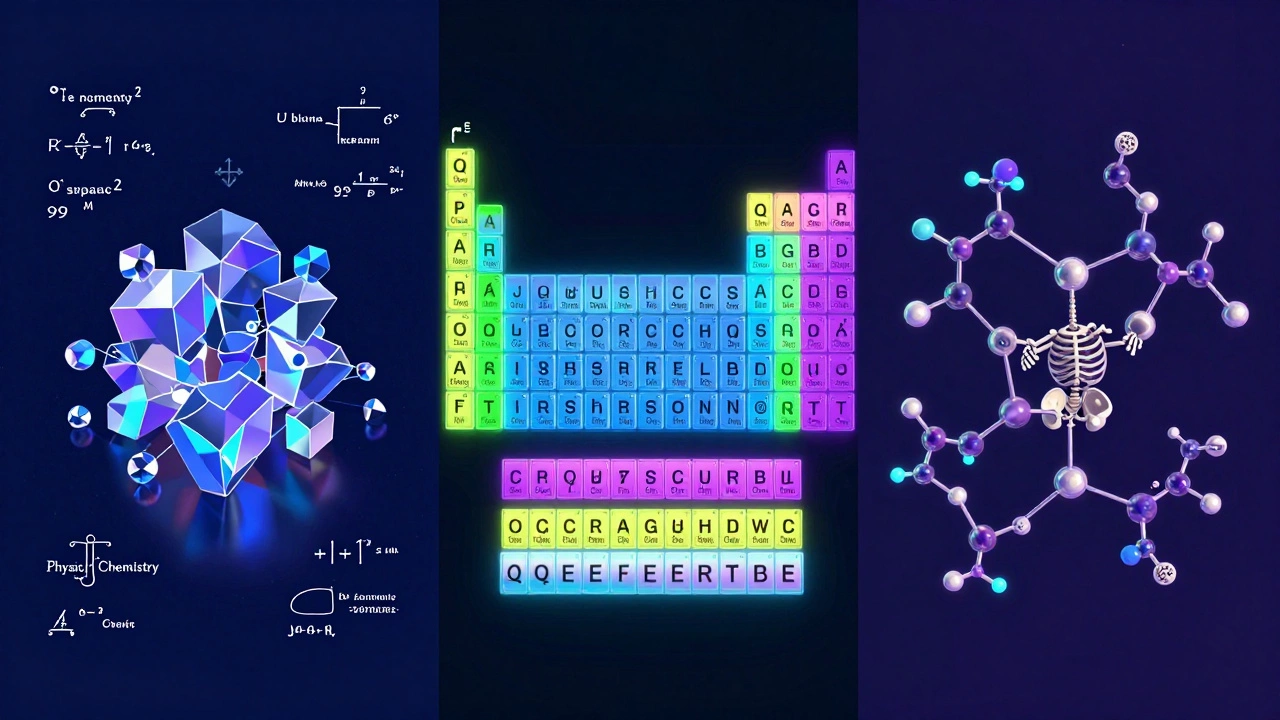
Chemistry is a weird beast because it's essentially three different subjects wrapped in one book. Physical Chemistry is the branch of chemistry dealing with the relationship between chemical systems and their physical properties is basically Math with a different name. Then you have Inorganic Chemistry, which is mostly a memory game of trends and exceptions. Finally, there is Organic Chemistry, the study of carbon-based compounds and their reactions, which often feels like learning a secret code.
| Branch | Primary Challenge | Study Approach | Key Skill |
|---|---|---|---|
| Physical | Numerical accuracy | Problem solving | Mathematical logic |
| Inorganic | Rote memorization | Active recall / Flashcards | Pattern recognition |
| Organic | Reaction mechanisms | Flowcharts / Mapping | Visualization |
The reason Chemistry is often cited as the toughest is this cognitive switching. You can't use the same part of your brain to solve a thermodynamics problem as you do to memorize the properties of Lanthanides. The most common pitfall is ignoring the 'exceptions' in the periodic table. In CBSE, the exceptions are often exactly what show up on the exam.
Commerce and the Accountancy Wall
It's not just the Science stream that has its struggles. For Commerce students, Accountancy is the process of recording financial transactions and preparing financial statements is frequently the biggest hurdle. Unlike History or Business Studies, Accountancy is unforgiving. A single digit error in a journal entry can wreck a Balance Sheet, leading to a cascade of errors that make the entire answer wrong.
The difficulty here isn't necessarily the complexity of the concepts-debit and credit are simple enough-but the volume and the pressure for absolute precision. When you're dealing with Partnership accounts or Company accounts in Class 12, the problems become long and tedious. The mental stamina required to stay focused for a 3-hour exam without making one small calculation error is what makes this subject a nightmare for many.
Humanities: The Battle Against Volume
Many people assume Humanities is the 'easy' route, but that's a myth. While you might not be solving for 'x', you're dealing with a massive amount of information. History is the study of past events, particularly in human affairs in the CBSE syllabus is an endurance test. You aren't just memorizing dates; you're analyzing socio-economic shifts and political revolutions.
The challenge here is the subjective nature of the marking. In Math, you're either right or wrong. In History or Political Science, your grade depends on how well you structure your argument and how effectively you integrate evidence. Writing a 6-mark answer that is both comprehensive and concise requires a level of critical thinking that many students aren't taught. The 'toughness' here is the gap between knowing the facts and knowing how to write them for an examiner.
How to Identify Your Own 'Toughest' Subject
If you're still not sure where you stand, look at your study patterns. Are you avoiding a specific book? Do you feel an immediate sense of dread when you open a certain chapter? That's your red flag. Usually, the subject we find 'toughest' is simply the one where we have the biggest gap in our foundational knowledge. If you hate Physics, it's probably because you didn't fully grasp basic vectors three years ago.
To fix this, stop trying to 'push through' the current chapter. Go back one level. If Class 12 Organic Chemistry is impossible, spend a weekend reviewing the basics of covalent bonding from Class 10. Once the foundation is solid, the 'tough' subject suddenly becomes manageable. It's not a lack of intelligence; it's a missing link in the chain of learning.
Strategies for High-Stress Subjects
Regardless of which subject is your enemy, the strategy to defeat it is the same. First, move away from passive reading. Highlighting a textbook with a yellow marker is not studying; it's coloring. Instead, use Active Recall. Close the book and try to write down everything you remember about a topic on a blank sheet of paper. Whatever you can't remember is where your actual study session should begin.
Second, use Spaced Repetition. Don't spend ten hours on Math on a Sunday and then ignore it for two weeks. Spend one hour every day. This prevents the 'forgetting curve' from wiping out your progress. For subjects like Chemistry or Biology, use flashcards for the memory-heavy parts and save your peak energy hours for the problem-solving parts of Physics and Math.
Is Mathematics actually the hardest subject in CBSE?
For many, yes, because it requires a high level of abstract thinking and consistent practice. However, it is objectively the most 'predictable' subject because once you understand a concept, you can solve any problem of that type. This makes it a high-scoring subject for those who master the basics.
Why do students find Physics more difficult than Chemistry?
Physics requires the simultaneous use of conceptual visualization and mathematical application. While Chemistry has a lot to memorize, Physics demands that you apply a law to a specific, often complex, scenario, which is a higher level of cognitive processing.
How can I score well in 'boring' or 'dense' subjects like History?
Stop treating History as a list of dates. Treat it as a series of cause-and-effect stories. Use mind maps to connect a political event to its economic cause and social consequence. This makes the information stick and helps you write the analytical answers that CBSE examiners look for.
What is the best way to handle Organic Chemistry?
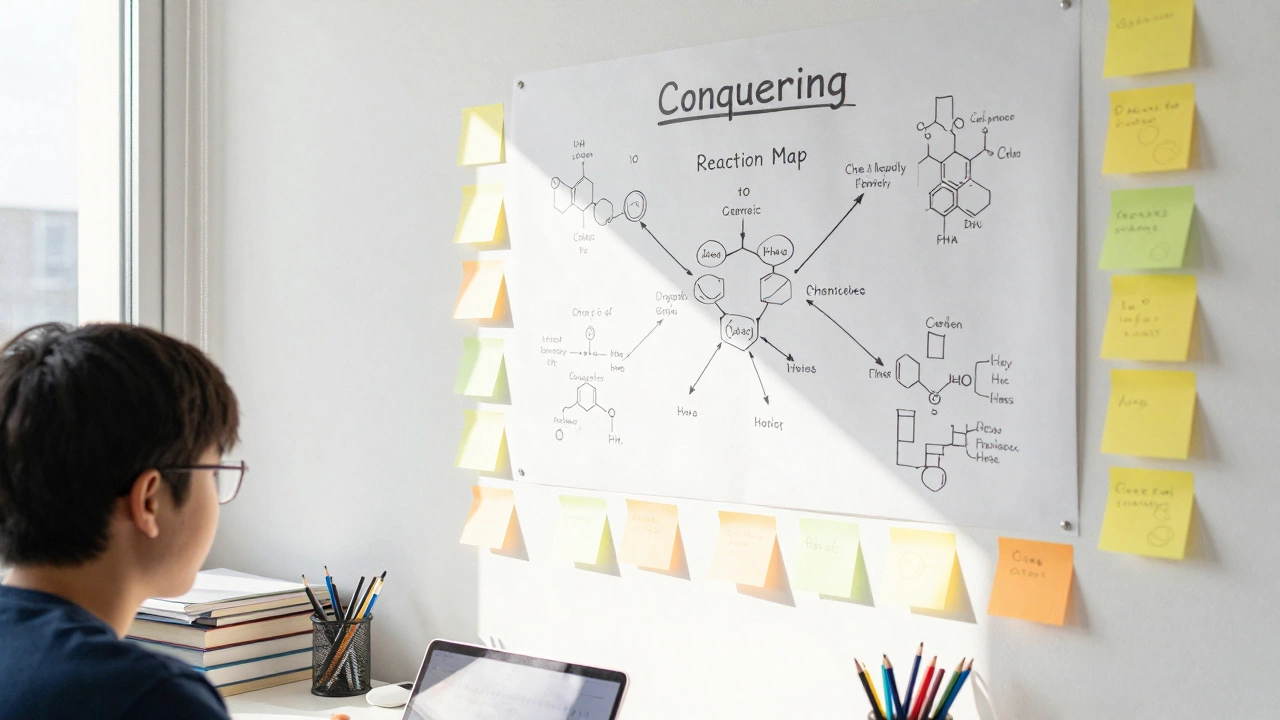
Create a 'Reaction Map' on a large piece of paper. Put the main compounds in the center and draw arrows to show how one transforms into another. Seeing the connections visually is much more effective than reading a list of reactions in a textbook.
Are there any tips for avoiding mistakes in Accountancy?
The best tip is to develop a 'checking habit' as you go. Don't wait until the end of the Balance Sheet to check your work. Verify each journal entry and ledger posting immediately. Additionally, practice timing yourself to reduce the panic that leads to simple calculation errors.
Next Steps for Your Study Plan
If you've identified your toughest subject, don't panic. Start by auditing your previous year's marks to see where you're losing points. Are you losing marks on conceptual questions (which means you need better theory) or on calculation errors (which means you need more practice)? Once you know the type of failure, you can apply the specific fix. For most students, a combination of a structured timetable and a shift toward active testing is enough to turn a 'nightmare' subject into a strength.