
Code Math Calculator
How Math Works in Real Coding
Most coding tasks use basic arithmetic operations. This calculator shows how you'll use addition, subtraction, multiplication, and division in actual programming scenarios.
Result:
E-commerce Tax Calculation
Example: Calculate 8% tax on a $25 item
$25 × 0.08 = $2.00 tax
Video Progress Tracking
Example: Calculate remaining time
120s (total) - 45s (current) = 75s remaining
Ever started learning to code and panicked because you weren’t sure if you needed to be good at math? You’re not alone. A lot of people think coding is for math geniuses - people who solve equations in their sleep. But here’s the truth: coding doesn’t require advanced math for most real-world tasks. You don’t need calculus to build a website. You don’t need algebra to make a mobile app work. And you definitely don’t need to love quadratic equations to land your first job as a developer.
What kind of math do you actually use in coding?
It depends on what you’re building. For the vast majority of coders - especially beginners - the math involved is basic arithmetic: addition, subtraction, multiplication, division. You’ll use these every day when you’re calculating how much something costs, figuring out percentages for discounts, or counting how many users clicked a button.
Let’s say you’re building a simple e-commerce site. You need to add tax to a $25 item. That’s 25 × 0.08 = 27. That’s it. No formulas. No complex logic. Just multiplication. Or maybe you’re writing code that shows how many minutes are left in a video. You subtract the current time from the total length. That’s subtraction. Simple.
When you start working with arrays or loops, you’ll use counting - like “for each item in this list, do something.” That’s not math. That’s logic. And logic is what coding is really built on.
When does math actually matter in coding?
There are exceptions. If you’re diving into areas like game development, data science, machine learning, or graphics programming, then yes - math becomes more important. But even then, you don’t need to be a math professor to start.
In game development, you might need to understand vectors to move a character across the screen. That sounds scary, but most game engines (like Unity or Godot) have built-in functions that handle the math for you. You just plug in numbers: “move left 5 units.” The engine does the rest.
In data science, you’ll see statistics: averages, percentages, correlations. But again, libraries like Python’s Pandas or NumPy do the heavy lifting. You don’t need to calculate standard deviation by hand. You just write one line of code and let the computer handle it.
Machine learning sounds like pure math - and it is, at the research level. But if you’re using pre-built models (which most people do), you’re mostly choosing the right tool and feeding it good data. You’re not deriving the algorithm from scratch.
What skills actually matter more than math?
Problem-solving. Patience. Attention to detail. The ability to break big problems into small steps. These are the real superpowers in coding.
Think of coding like cooking. You don’t need to be a food scientist to make a good pasta dish. You need to follow a recipe, adjust seasoning, and learn from mistakes. Same with code. You write a line, test it, fix the error, try again. That’s the rhythm.
Another skill that matters way more than math: reading documentation. Most of what you’ll do as a coder isn’t inventing new math - it’s looking up how a function works, copying examples, and adapting them to your needs. Google and Stack Overflow are your best friends.
What do real beginners actually do in their first coding classes?
Take a typical beginner course in Python or JavaScript. You’ll start by printing text to the screen. Then you’ll write code that asks for a user’s name and says hello. Then you’ll make a calculator that adds two numbers. Then you’ll build a to-do list app.
None of that requires anything beyond elementary math. You’re not solving integrals. You’re not graphing parabolas. You’re telling a computer what to do, step by step. That’s logic. That’s structure. That’s communication.
One student I talked to - a 32-year-old mom switching careers - had never taken a math class since high school. She struggled with fractions. But she built her first website in six weeks. Why? Because she focused on patterns, not formulas. She learned how to spot when code was broken and how to fix it. That’s the heart of coding.
Why does the myth that coding needs math still exist?
It comes from a few places. First, computer science degrees often require calculus and discrete math. That’s because universities teach theory - how algorithms work, how memory is managed, how data structures are optimized. That’s useful if you want to design new programming languages or work at Google Research. But it’s not what most people need to get hired as a junior developer.
Second, early programming tutorials sometimes use math-heavy examples - like calculating Fibonacci sequences or prime numbers - because they’re easy to test and look impressive. But those are just exercises. Real-world apps rarely need them.
Third, some people assume that because computers are logical, you need to be a math person to understand them. But computers follow rules. You just need to learn the rules. It’s like learning a new language. You don’t need to be a linguist to speak Spanish. You just need to practice.
What should you focus on instead of math?
Start with these five things:
- Understanding how variables work - storing and changing values
- Writing simple conditions - if this, then that
- Using loops to repeat actions
- Breaking problems into small pieces
- Reading error messages and fixing them
That’s it. That’s 80% of what you’ll do for your first year. You’ll spend more time debugging a typo than solving an equation.
Try this: Open a free coding platform like freeCodeCamp or Codecademy. Do the first 10 lessons in JavaScript or Python. You’ll see - no trigonometry. No matrices. Just clear instructions and small wins.
Can you learn to code if you’re bad at math?
Yes. Absolutely. Thousands of people do it every year. You don’t need to be good at math to be good at coding. You need to be willing to try, fail, and try again.
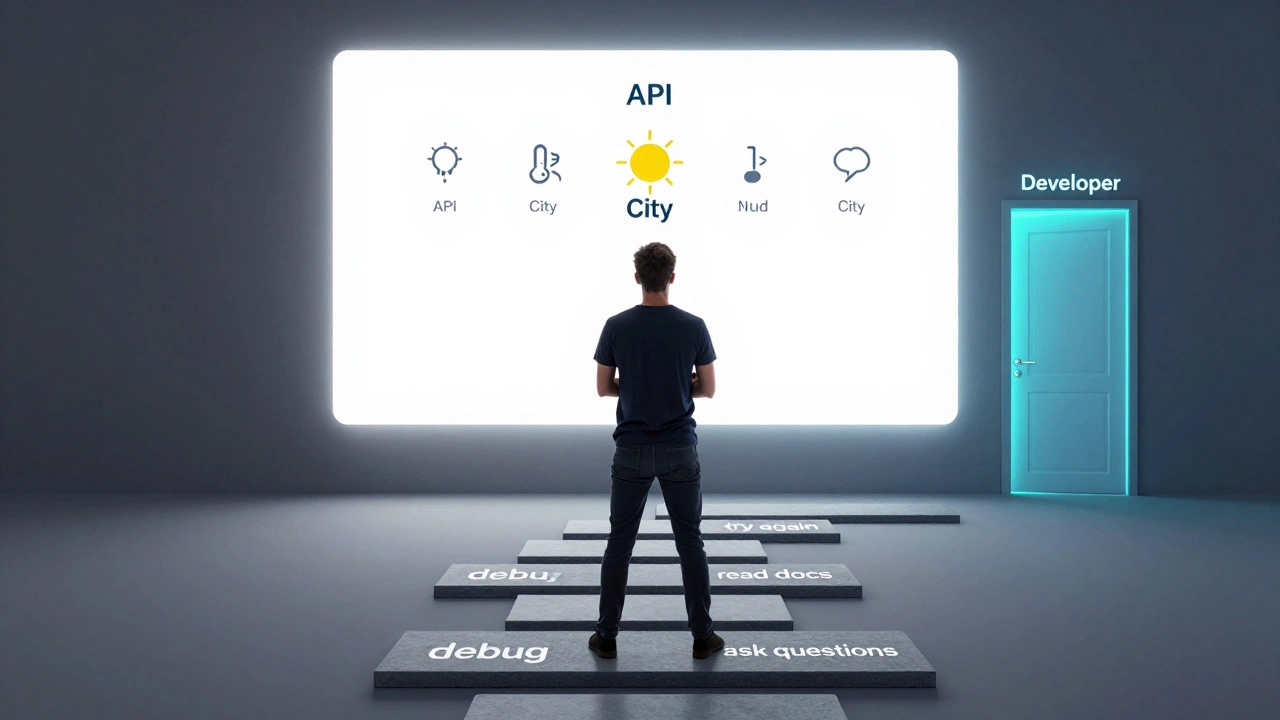
Here’s a real example: A friend of mine, a former retail worker, took a coding bootcamp. She hated math in school. She couldn’t remember the Pythagorean theorem. But she learned to build a weather app using an API. She didn’t calculate the temperature - she just asked the API for it and displayed it on the screen. That’s coding. That’s all it took.
If you’re worried about math, forget it. Focus on curiosity. Ask questions. Break things. Fix them. Repeat.
What about advanced roles? Do you need math then?
If you ever move into AI, robotics, financial modeling, or scientific computing, you’ll need more math. But even then, you learn it as you go. Most professionals don’t know all the math upfront. They learn the specific formulas they need for their project.
Think of it like driving. You don’t need to know how an engine works to drive a car. You just need to know how to steer, brake, and follow traffic rules. Same with coding. You don’t need to understand every bit of math behind the tools - you just need to know how to use them.
And if you do decide to go deeper? There are plenty of resources - Khan Academy, 3Blue1Brown on YouTube, free tutorials - that teach math in a practical, visual way. You learn it when it’s useful, not before.
Final thought: Coding is about thinking, not calculating
Math is a tool. Coding is a craft. You don’t need to be a mathematician to be a carpenter. You just need to know how to use a hammer, measure twice, and cut once.
Start coding. Don’t wait until you’re good at math. You’ll learn what you need along the way - and you’ll be surprised how little you actually needed to begin with.
Do I need to be good at math to learn coding?
No. Most beginner coding tasks only require basic arithmetic - adding, subtracting, multiplying, dividing. You don’t need algebra, calculus, or geometry to start. The real skills you need are problem-solving, patience, and the ability to follow instructions step by step.
What math is used in programming?
For most programming jobs, you’ll use basic math: percentages, averages, counting, and simple formulas. In game development, you might use vectors or trigonometry - but most engines handle it for you. In data science, you’ll work with statistics, but libraries like Pandas do the calculations. You rarely need to do math by hand.
Can someone who struggled with math in school learn to code?
Yes. Many successful coders had trouble with math in school. Coding is about logic, not calculation. One person I know failed high school algebra but built a working mobile app in three months by focusing on small projects, reading error messages, and practicing daily. Math anxiety doesn’t block coding success.
Is coding more like math or language?
Coding is more like learning a language than doing math. You learn vocabulary (keywords like if, for, while), grammar (syntax rules), and how to structure sentences (functions and loops). You make mistakes, fix them, and get better over time - just like speaking a new language.
Do I need to take calculus before starting coding classes?
No. No coding class for beginners requires calculus. Even in college computer science programs, you take math courses separately. You can start coding today with zero math background and learn what you need as you go. The only thing you need is curiosity and persistence.