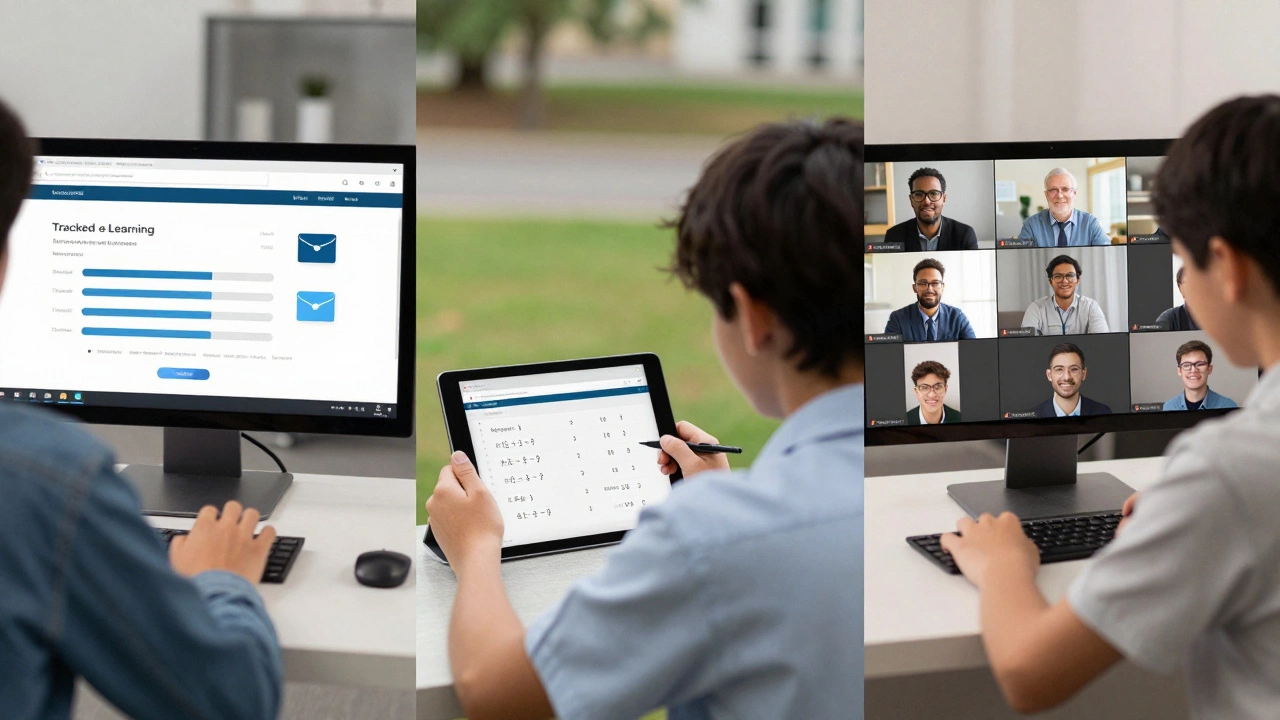
When people say "eLearning," they’re not talking about some new tech buzzword-they’re talking about the way millions of students and workers learn today. But here’s the thing: "eLearning" isn’t the only name for it. You’ve probably heard "online learning," "digital learning," or even "distance education." So what’s the difference? And why does it matter?
It’s Not Just One Thing
eLearning is a broad term, and like "car" or "phone," it covers a lot of different setups. Some people use "eLearning" to mean any course you take on a screen. Others use it only for structured programs with quizzes, progress tracking, and certificates. The truth? It depends on who you ask.
In schools, teachers might call it "distance education"-especially if students aren’t in the same room. In companies, HR teams say "digital learning" when they’re training staff on new software. Universities often use "online learning" when they’re offering full degrees over the internet. And in tech circles? They just say "learning management system" or LMS.
There’s no single official definition. The U.S. Department of Education defines eLearning as "instructional content delivered through electronic technologies." That’s it. No fancy jargon. No strict rules. Just content you access online.
What People Actually Call It
Let’s break down the common names you’ll run into:
- eLearning - Often used by corporations and government agencies. It implies a system with tracking, assessments, and sometimes automation. Think: employees finishing mandatory compliance training.
- Online learning - The most common term for students. Used by platforms like Coursera, Udemy, or Khan Academy. It’s casual, clear, and widely understood.
- Digital learning - Broader than just internet-based courses. Includes apps, videos, interactive simulations-even offline apps that sync later. Used in K-12 schools and adult education.
- Distance education - The oldest term. Originally meant correspondence courses by mail. Now it’s used by accredited universities offering fully remote degrees.
- Virtual classroom - Not the same as eLearning. This refers to live, real-time sessions with an instructor. Zoom classes, live webinars, or synchronous Zoom lectures fall here.
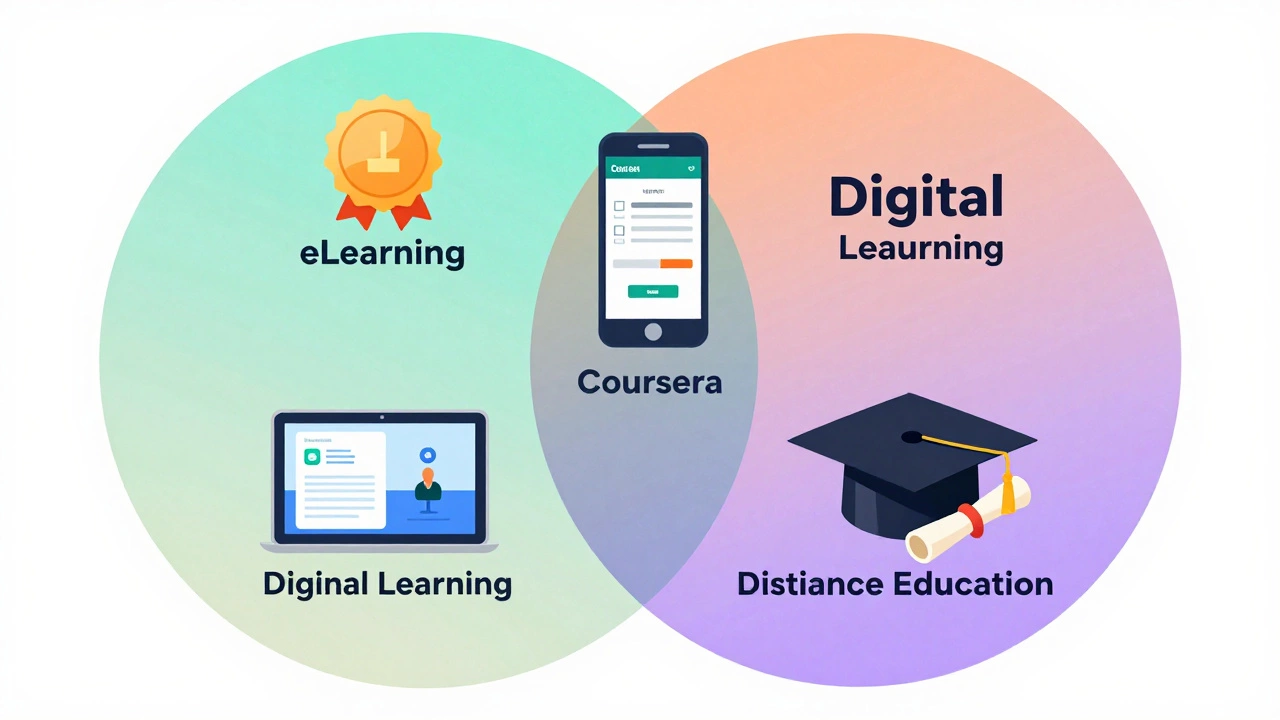
These aren’t synonyms. They’re overlapping categories. You can have a course that’s all three: online learning, digital learning, and eLearning. But not every digital learning experience is eLearning.
Why the Confusion?
The confusion comes from history. Back in the 1990s, "distance education" was the only term. Then the internet arrived. Suddenly, you could watch lectures, submit assignments, and get feedback-all without leaving your house. That was "online learning."
Then came smartphones. Now you can learn on a tablet, a smartwatch, even a voice assistant. That’s "digital learning." Companies started using learning platforms like Moodle or Canvas to track employee progress. That became "eLearning."
Each term grew out of a different need:
- Universities needed accreditation-so they stuck with "distance education."
- Corporations needed tracking-so they used "eLearning."
- Consumers just wanted to learn something new-so they said "online learning."
There’s no governing body that says "only one term is correct." That’s why you’ll see "eLearning" on a corporate training portal and "online learning" on a student’s Facebook post.
What’s the Best Term to Use?
Here’s the simple rule: use the term that matches your audience.
- If you’re a student signing up for a course? Say "online learning."
- If you’re a manager setting up training for your team? Say "eLearning."
- If you’re a school district rolling out tablets and apps? Say "digital learning."
- If you’re applying to a university that lets you earn a degree remotely? They’ll say "distance education."
Don’t overthink it. The technology doesn’t care what you call it. What matters is whether you can access the material, finish the lessons, and actually learn something.

Real-World Examples
Let’s look at three real cases:
- Case 1: A nurse in Christchurch finishes her annual certification through her hospital’s portal. She gets a certificate, tracks her hours, and answers quiz questions. That’s eLearning a structured, tracked form of online education often used in corporate or professional settings.
- Case 2: A high school student in Dunedin watches YouTube videos on calculus and uses an app to practice problems. No teacher, no login, no certificate. That’s digital learning the use of digital tools and media to support learning, whether or not it’s formally organized.
- Case 3: A single parent in Auckland enrolls in an accredited online MBA program. She attends live lectures, submits papers, and graduates with a degree. That’s distance education a formal, accredited educational model where instruction occurs remotely, often leading to recognized qualifications.
Three different terms. Three different experiences. All under the same umbrella.
What You Should Remember
There’s no single "correct" name. The words "eLearning," "online learning," "digital learning," and "distance education" all point to the same core idea: learning without being in a physical classroom.
What changes is the context:
- Is it formal? Then it’s probably distance education or eLearning.
- Is it casual? Then it’s online or digital learning.
- Is it tracked? Then it’s eLearning.
- Is it live? Then it’s a virtual classroom.
Don’t get stuck on the label. Focus on the outcome: Can you access the material? Can you learn from it? Can you apply it? If yes, then you’re doing it right-no matter what you call it.
Is eLearning the same as online learning?
They overlap, but they’re not the same. Online learning is any course you take over the internet-like watching a YouTube tutorial or signing up for a free class on Coursera. eLearning usually means a structured, tracked system-often used in companies or schools-with quizzes, progress reports, and certificates. So all eLearning is online learning, but not all online learning is eLearning.
What’s the difference between digital learning and eLearning?
Digital learning is broader. It includes apps, videos, interactive games, and even offline tools that sync later. eLearning is more specific-it’s digital learning that happens on a platform with tracking, assessments, and usually a login. So digital learning can be anything from a mobile app to a virtual lab. eLearning is that same thing, but organized and measured.
Is distance education still used today?
Yes, especially in universities. When a school offers a fully online degree that leads to a diploma or certification, they often call it distance education. It’s the formal term used for accredited programs. Even though you’re using Zoom and learning management systems, the institution still uses "distance education" on their website and transcripts.
Can you do eLearning without the internet?
Technically, yes-but it’s rare. eLearning usually requires an online platform to track progress, deliver content, and issue certificates. But some systems let you download lessons and sync your progress later when you reconnect. In those cases, you’re still using an eLearning system, even if you’re offline. Still, the term implies connectivity.
Why do companies use "eLearning" instead of "online learning"?
Because "eLearning" implies structure. Companies need to track who completed training, when, and whether they passed. "Online learning" sounds casual-it could mean watching a video on YouTube. "eLearning" tells HR: this is a formal system with records, compliance, and accountability.